Ethan Sheehan
All work — September 2025

Integrated Test Campaign 2025

Three burns in September 2025: a 7 s full-duration burn measured at 3.99 kN peak, and a 5.58 kN peak on the last.

RolePropulsion Lead
Burns
3
Full-duration burn
7 s
Peak thrust
5.58 kN
01

The whole vehicle, horizontal

Astron Systems, 16 to 20 September 2025. Engine 1 had already proved itself on AEL's test cell in January; this time it fired as part of HyPower's complete 2025 launch vehicle stack, the flight tank standing vertical and the engine lying horizontal on the Astron stand. The point was the vehicle, not the engine: could the stack run its own engine for a full burn, and did the thrust curve get us off the rail fast enough for EuRoC? Three burns over the week answered both.
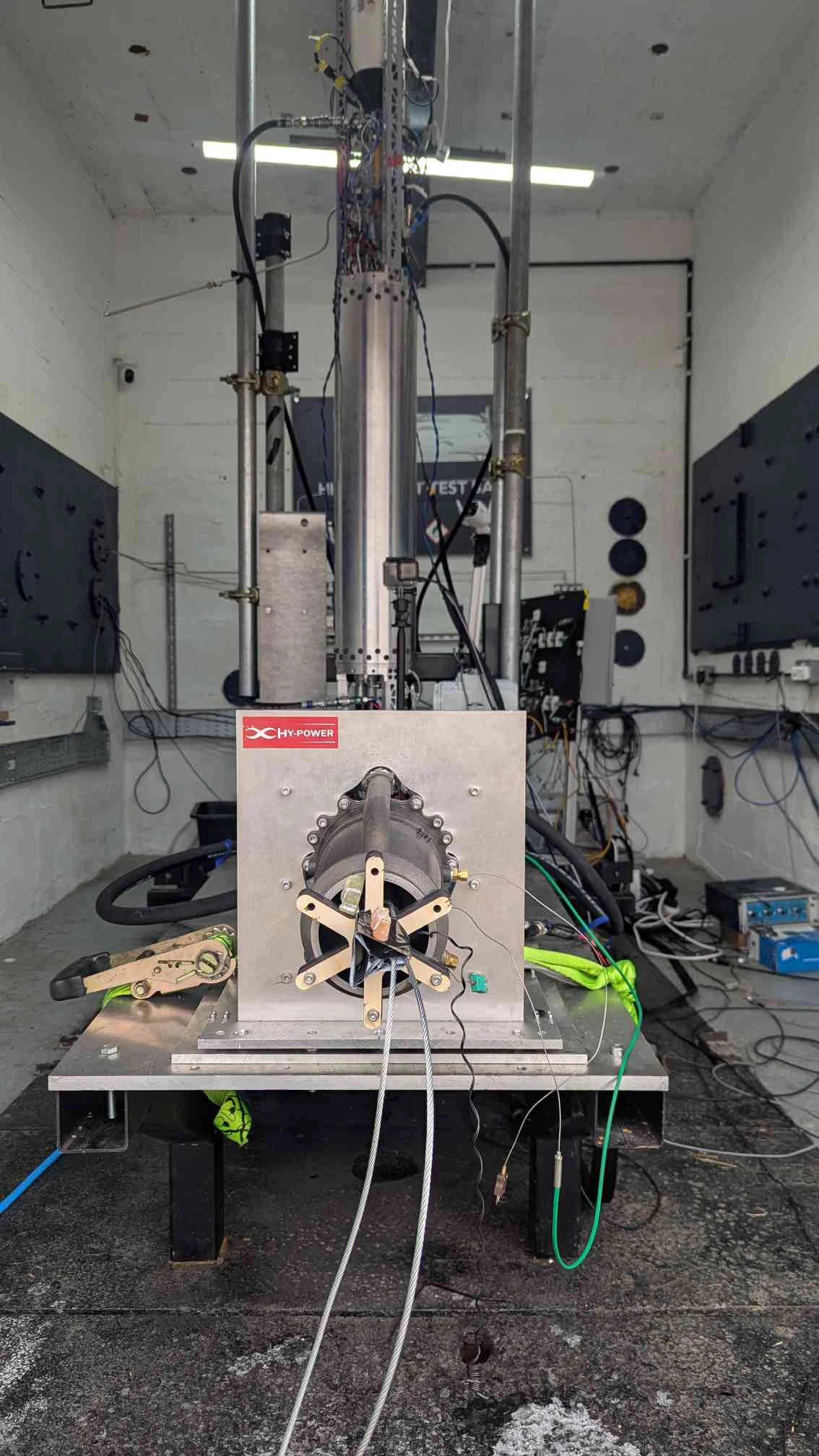
The 2025 stack in the Astron test bay: the flight tank standing vertical against the back wall, Engine 1 bolted horizontally to a plate at floor level behind a HyPower placard
The test configuration: tank vertical, engine horizontal.
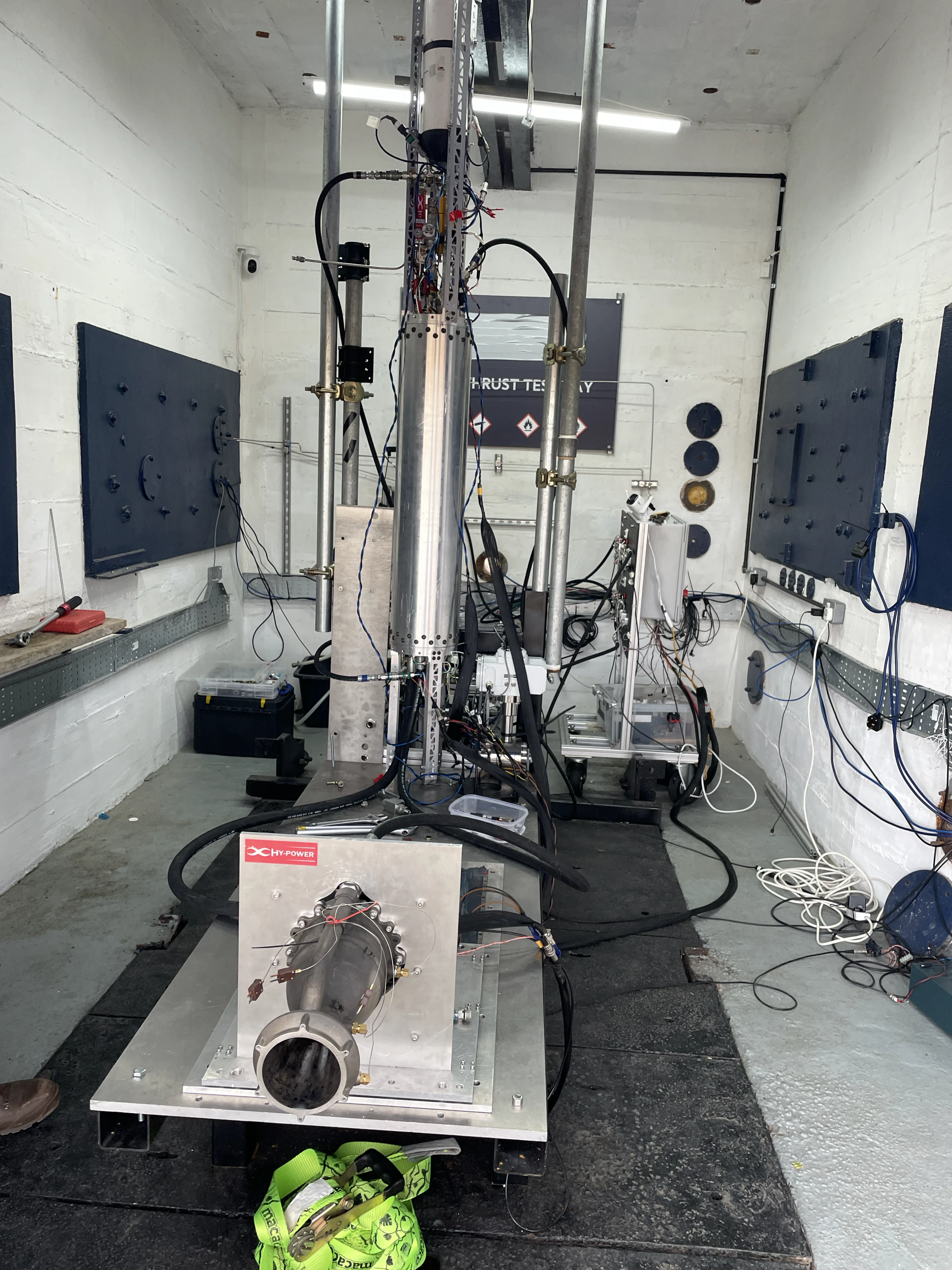
The same stack from closer in, the engine's nozzle pointing at the camera and the tank's feed lines and instrumentation running up the bay wall
Engine 1 on its plate under the flight tank.
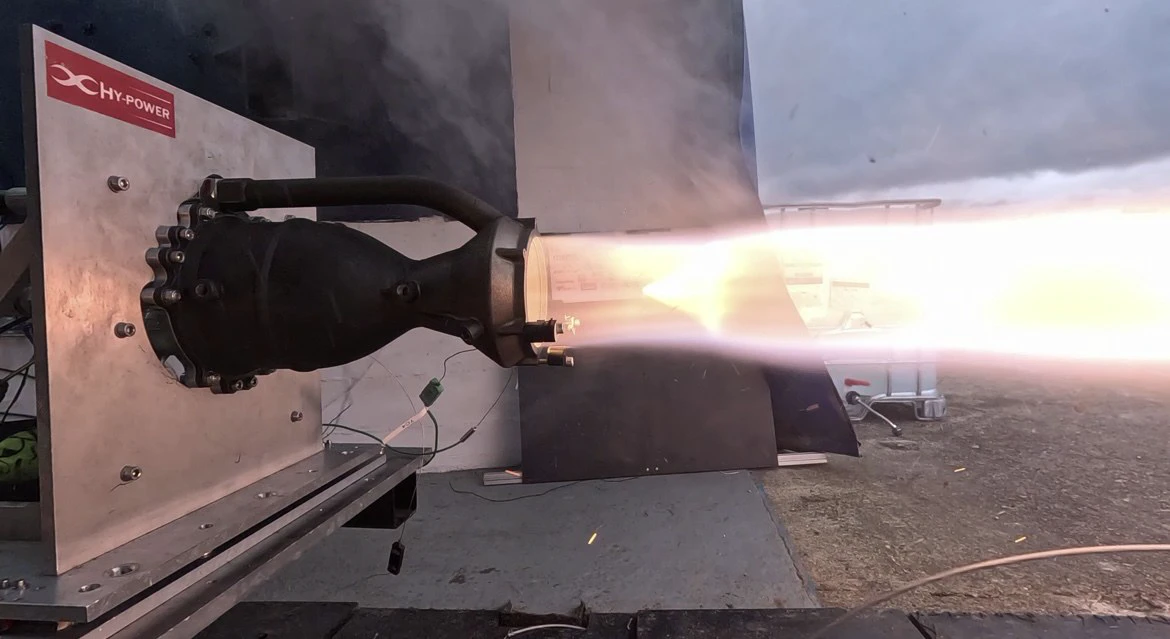
Engine 1 bolted horizontally to the Astron test stand under a HyPower placard, plume streaming right during a burn
Engine 1 on the Astron test stand.
02

Built in Bristol, fired at Westcott

The fluid panel, the run panel and the harness were built and cold-flowed in Bristol, then driven to Westcott and rebuilt in Astron's high-thrust bay: tank up the back wall, engine on a plate at floor level, every line re-made and leak-checked in place. Two of the five days went on that.
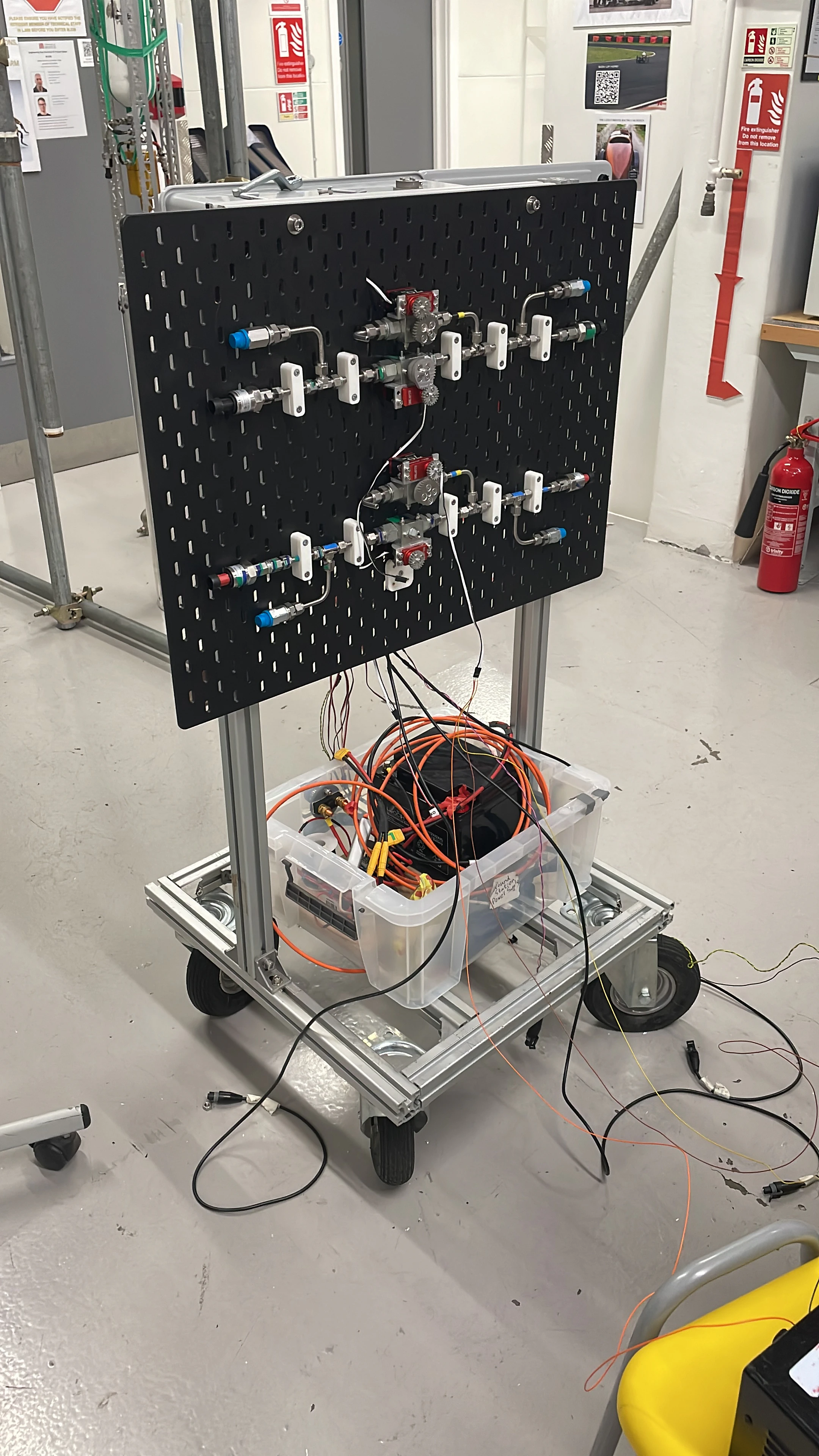
The fluid control panel on a trolley: a black perforated board carrying two rows of hand valves and solenoids, with a control box in a clear case underneath
The fluid panel, built in Bristol before the campaign.
The vehicle in a padded transit bag on tarmac, fin can spread out at one end
Packed for the drive to Westcott.
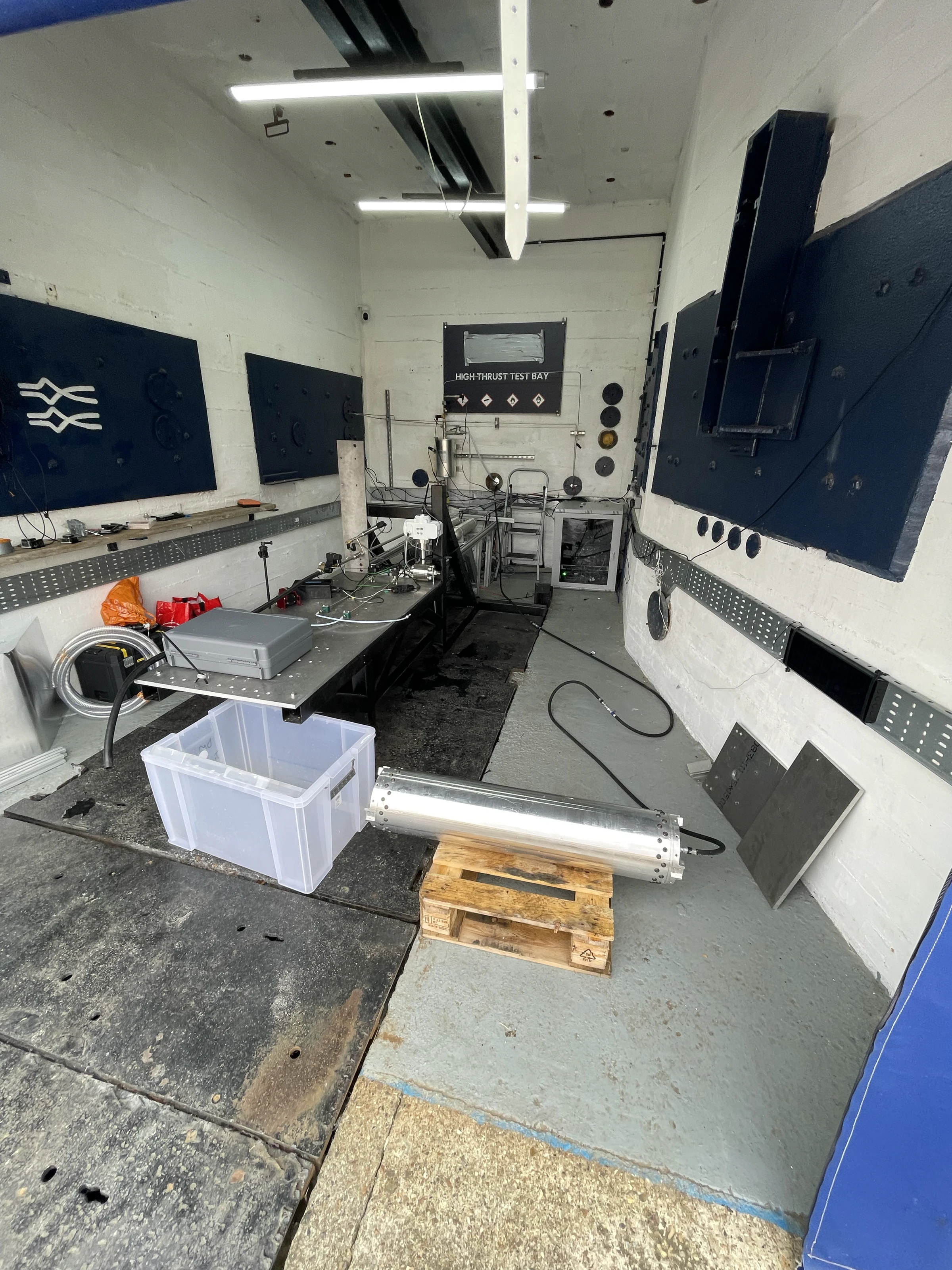
The empty high-thrust test bay at Astron: white walls, dark acoustic panels, a bare stand and the tank lying in a crate on the floor
The high-thrust bay before the stack went in.
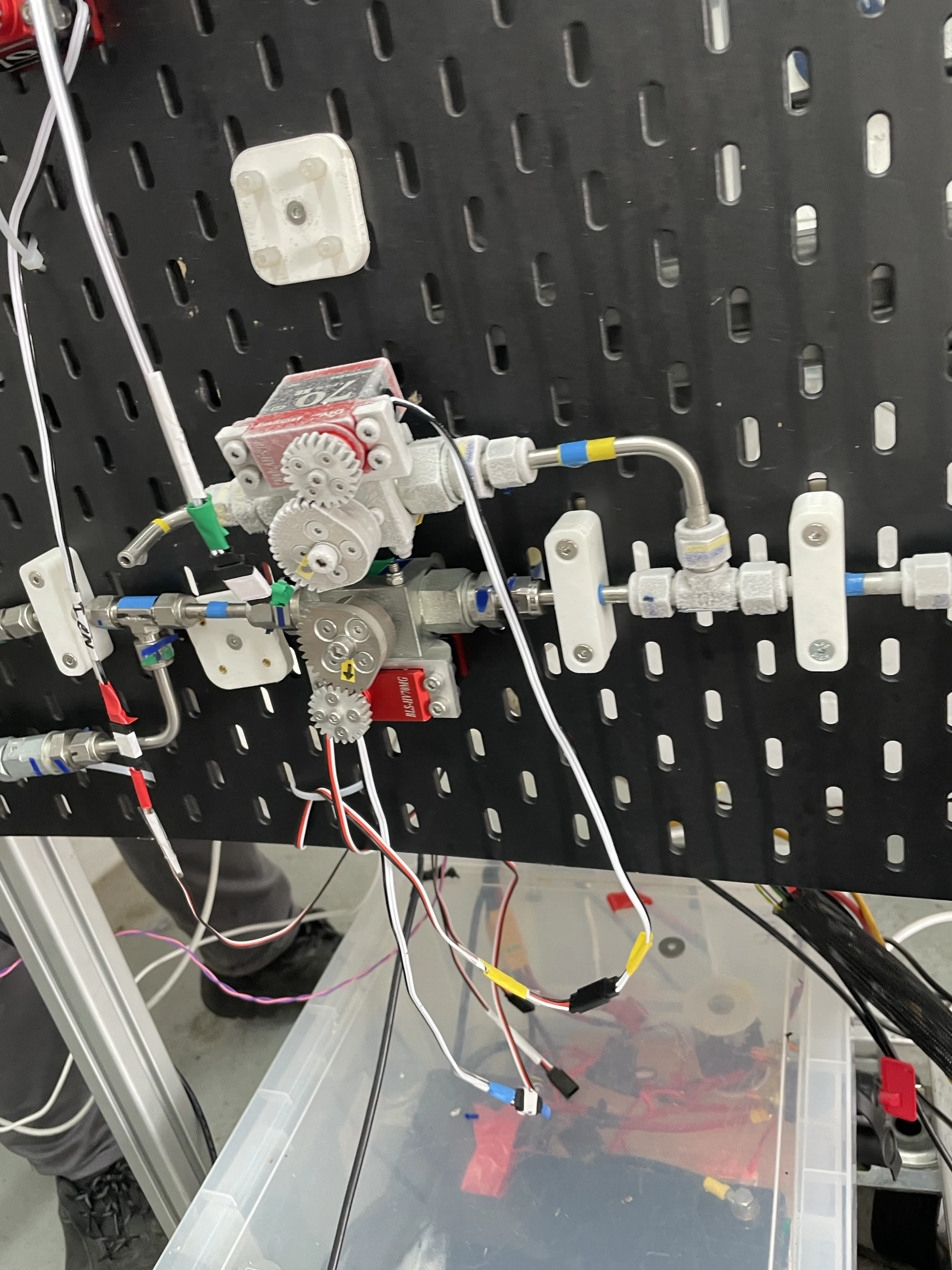
Close on the run panel in the bay: solenoid valves, fittings and colour-coded wiring on a black perforated board
The run panel in the bay.
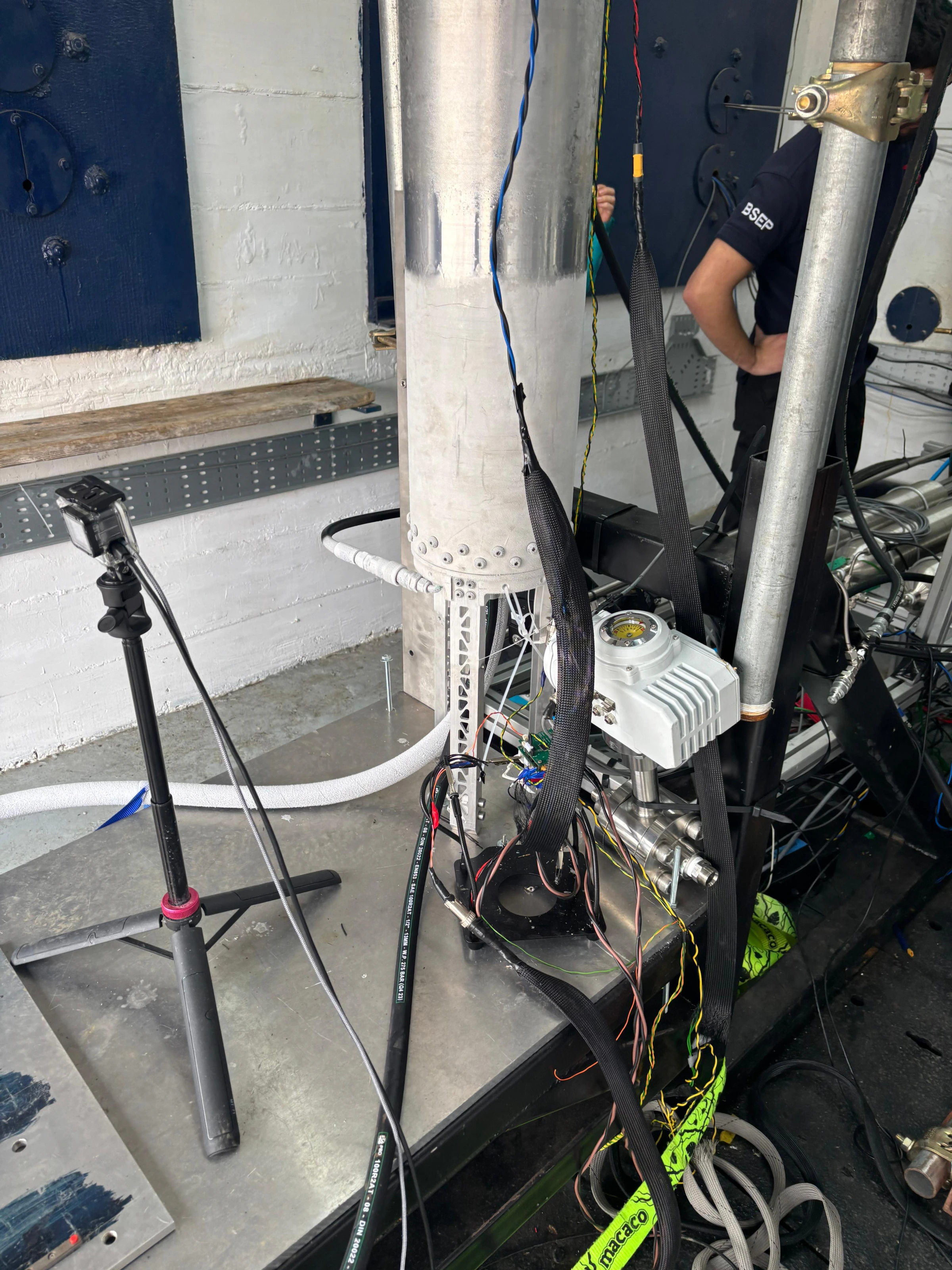
Close on the base of the vertical flight tank, wrapped in instrumentation cable with a camera tripod and pressure lines around it
The tank base, instrumented.
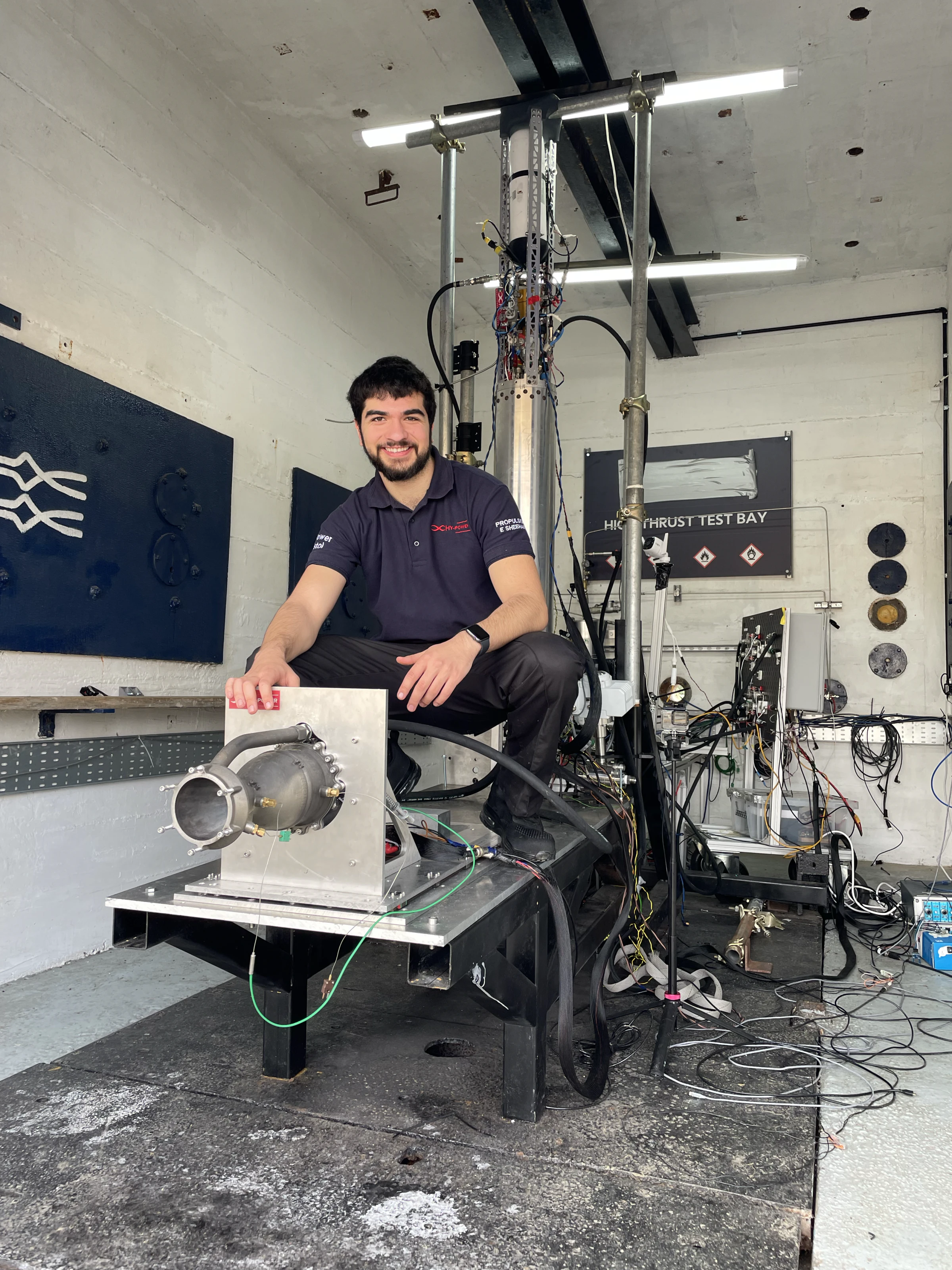
Ethan Sheehan sitting beside Engine 1 on its mounting plate in the test bay, the vertical tank and its plumbing behind him
Engine 1 mounted, the day of the full-duration burn.
03

Hotfire 1: one second on a part-empty tank

A nitrous leak during fuelling left the tank part-filled by the time we committed to the count. The engine lit off the sparkler and ran for about 1 s, peaking at 3.7 kN, before the oxidiser was gone. Chamber pressure got to 17.6 bar, close to the 20 bar design point, which said the engine was fine and the problem was upstream of it. Not the burn we wanted, but the first time the full stack had fired end to end.

Hotfire 1, wide. Sparkler ignition, about a second of burn, then the tank is empty.
04

Hotfire 1, frame by frame

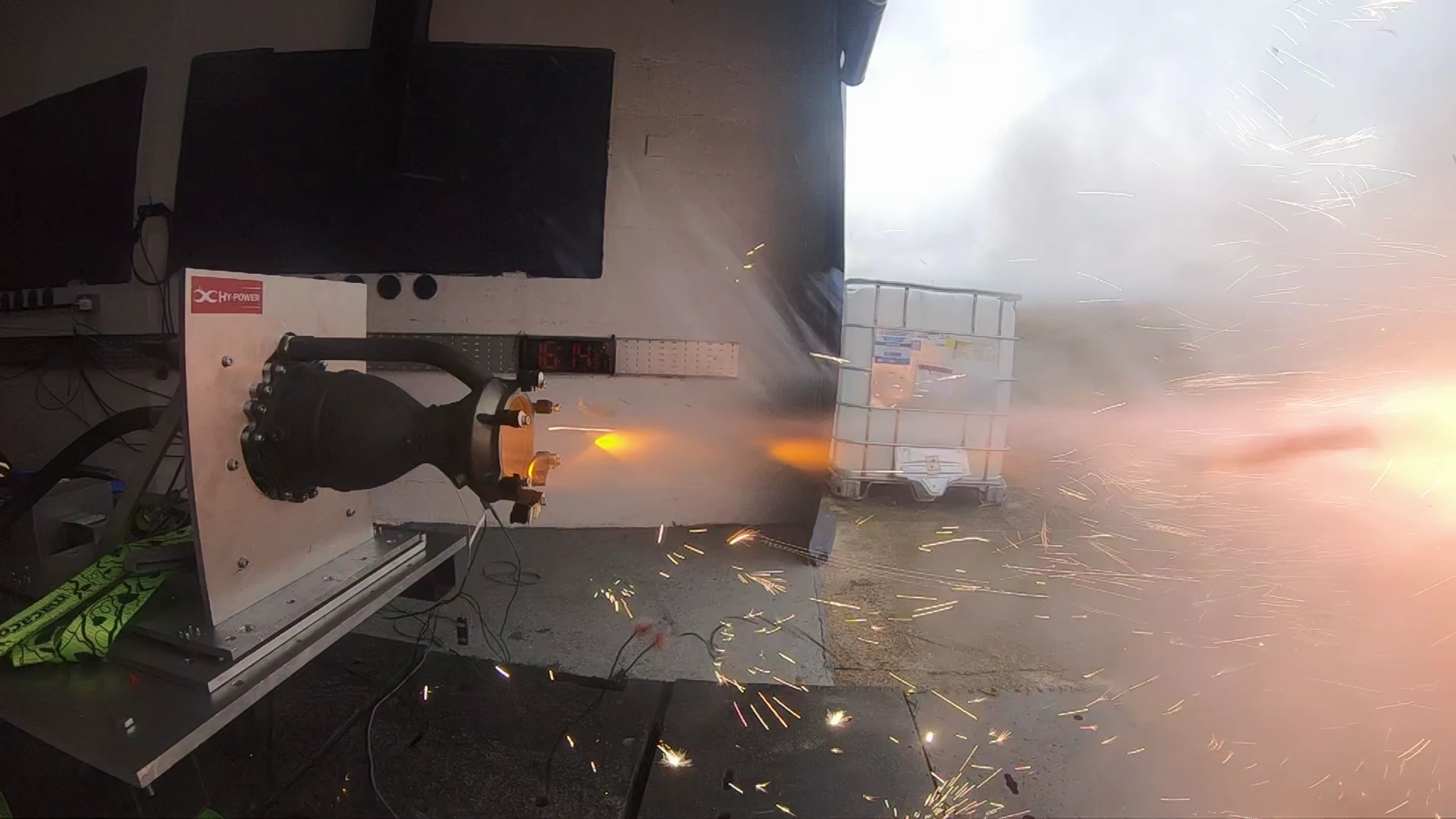
Ignition, the plume forming, the second it ran, and the tail-off as the tank emptied.
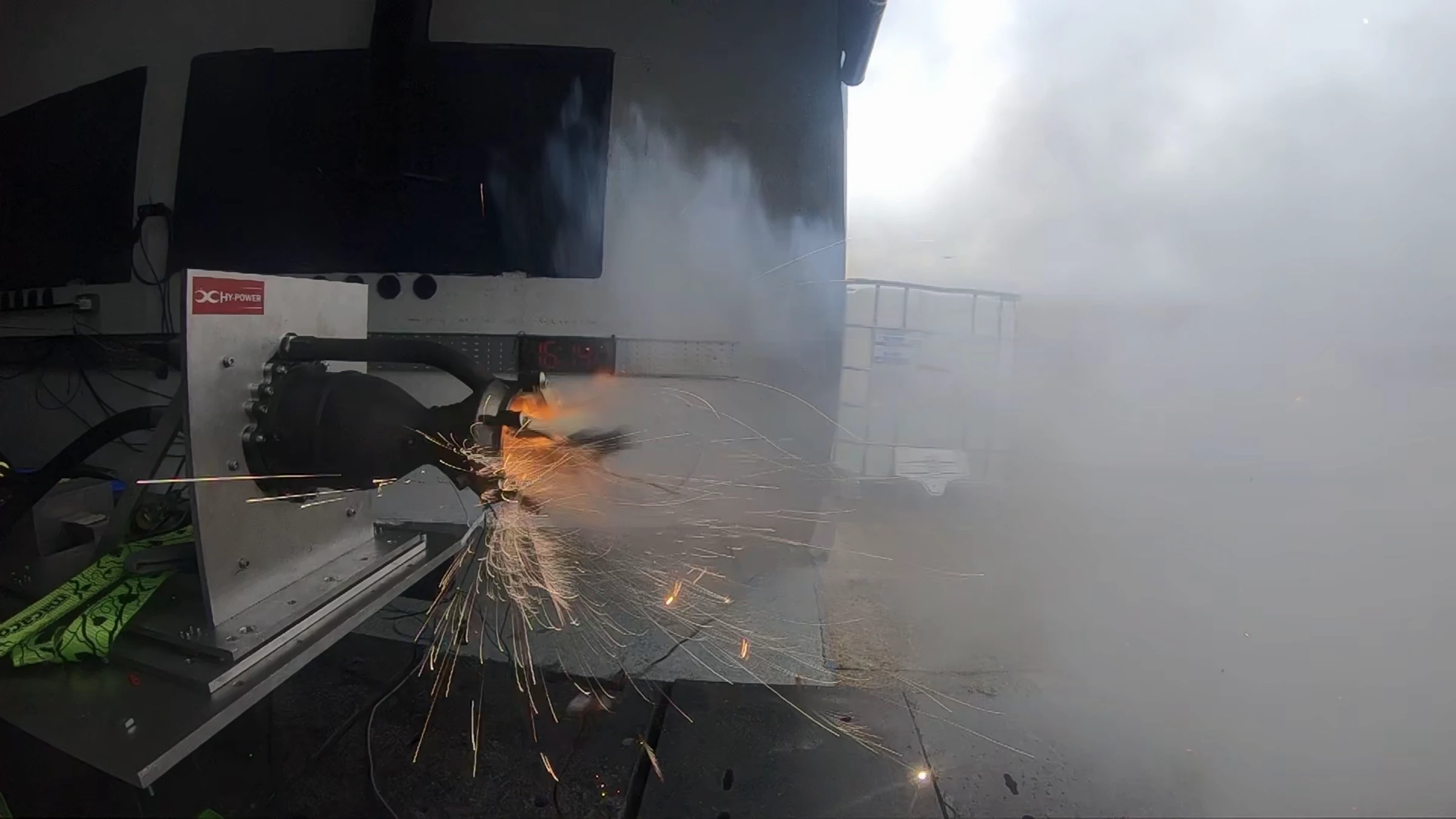
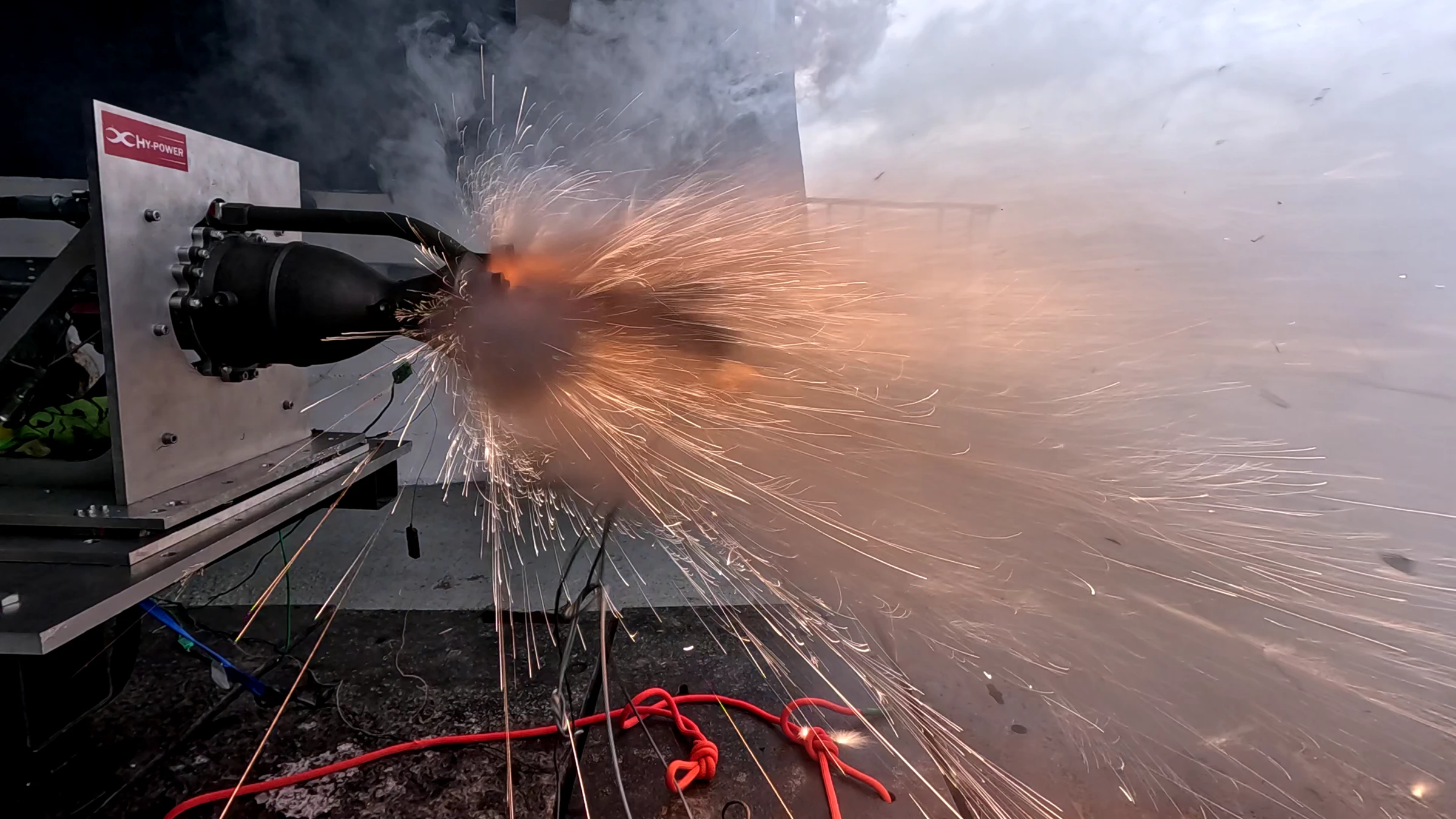
Hotfire 1 ignition: a fountain of sparks off the sparkler at the nozzle exit with vapour still hanging around the engine
Hotfire 1, ignition.
Hotfire 1 just after ignition, a short orange plume forming while sparks scatter across the pad below the engine
Hotfire 1, the plume forming.
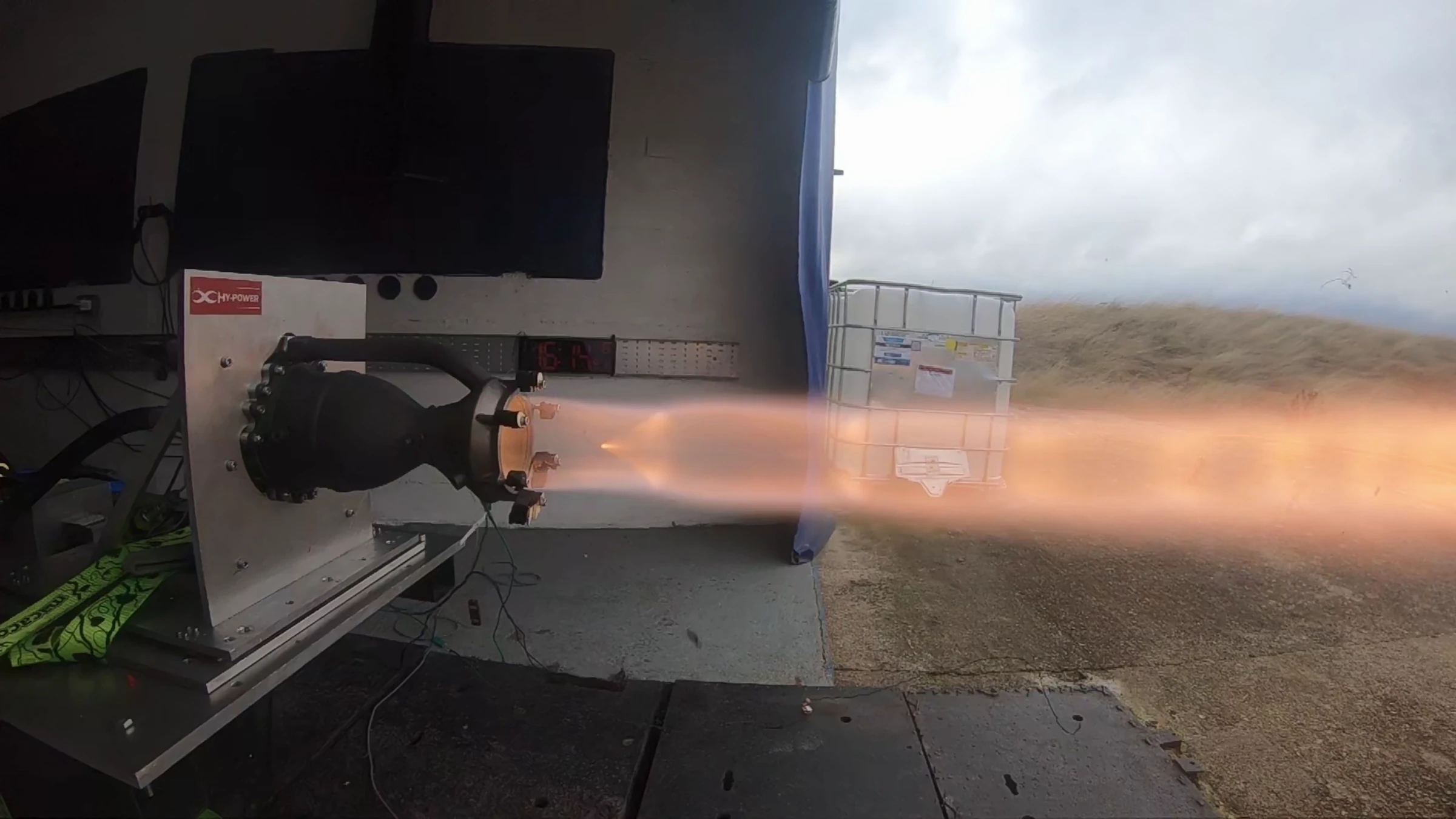
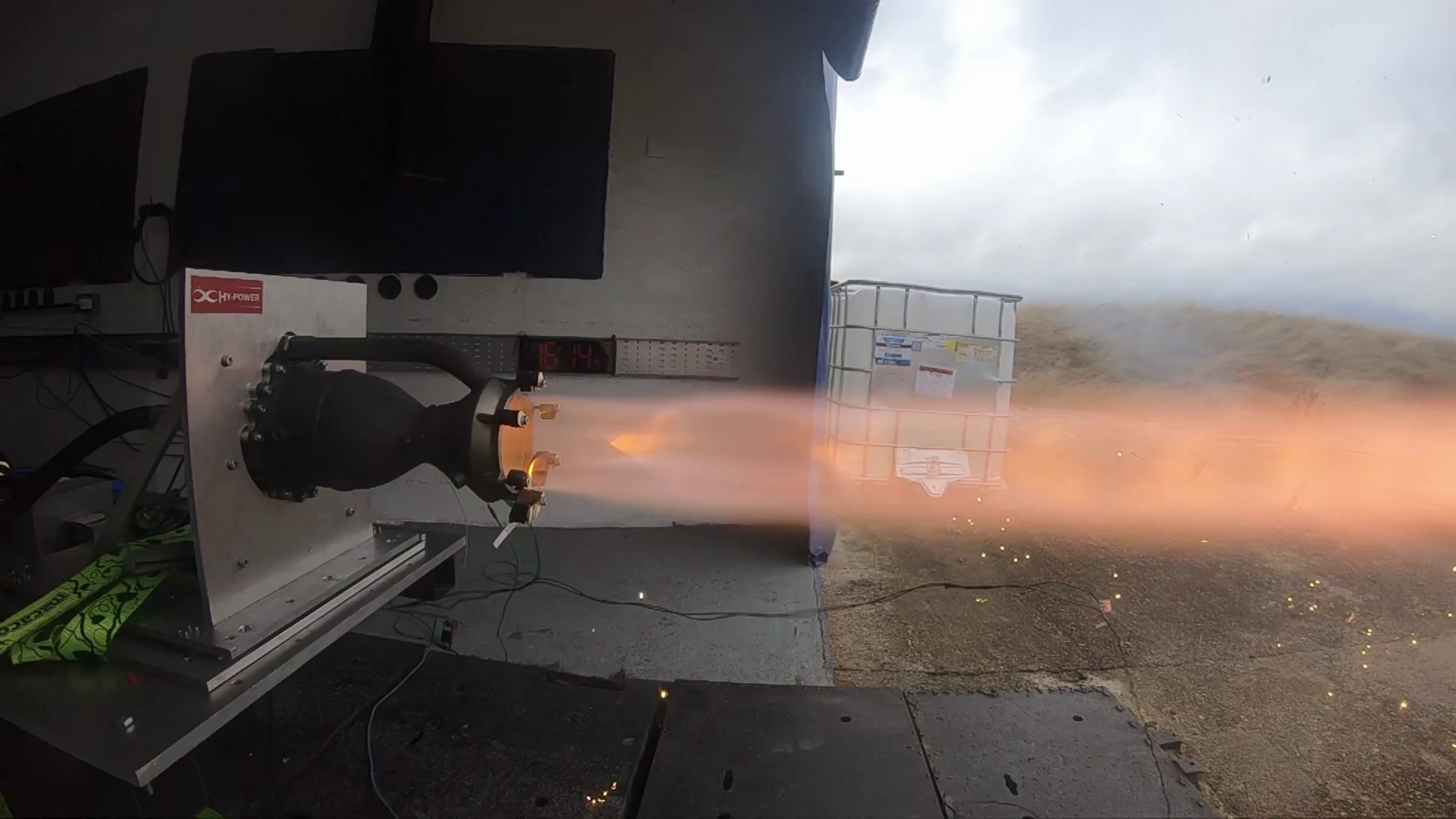
Hotfire 1 running: a translucent orange plume streaming right from the nozzle under an overcast sky
Hotfire 1, running on a part-empty tank.
Hotfire 1 near the end, the plume thinning as the oxidiser runs out
Hotfire 1, tailing off.
05

Hotfire 2: seven seconds

Full duration. The load cell measured 3.99 kN at the peak about a second in, decaying to 3.0 kN as the tank blew down, 3.50 kN mean and 24.7 kN.s of impulse over the burn. This was the data the qualification rested on: with the measured thrust curve in OpenRocket the vehicle leaves the rail at 30.7 m/s, against the 30 m/s EuRoC requires, with a stability margin of 1.52.

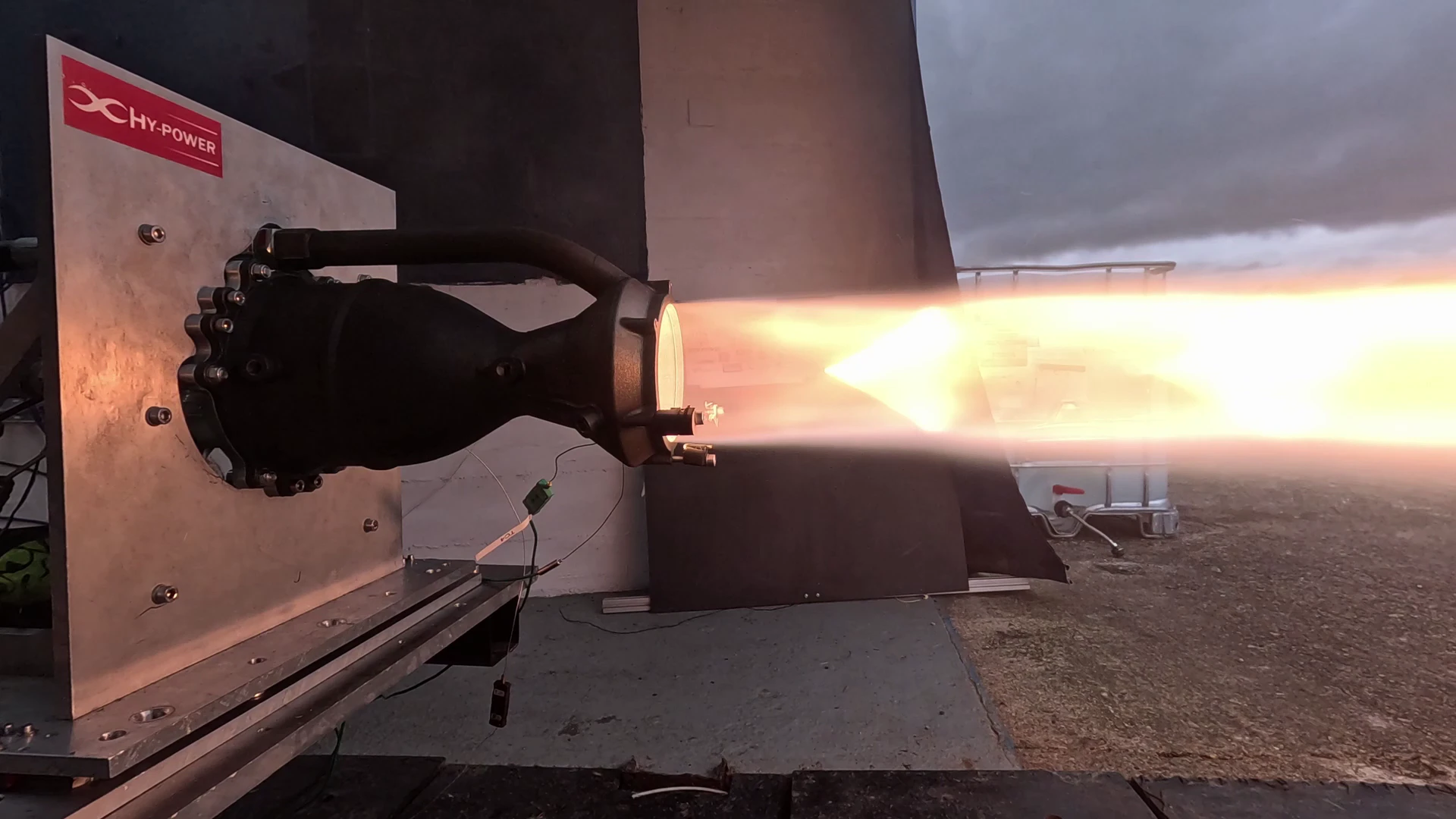
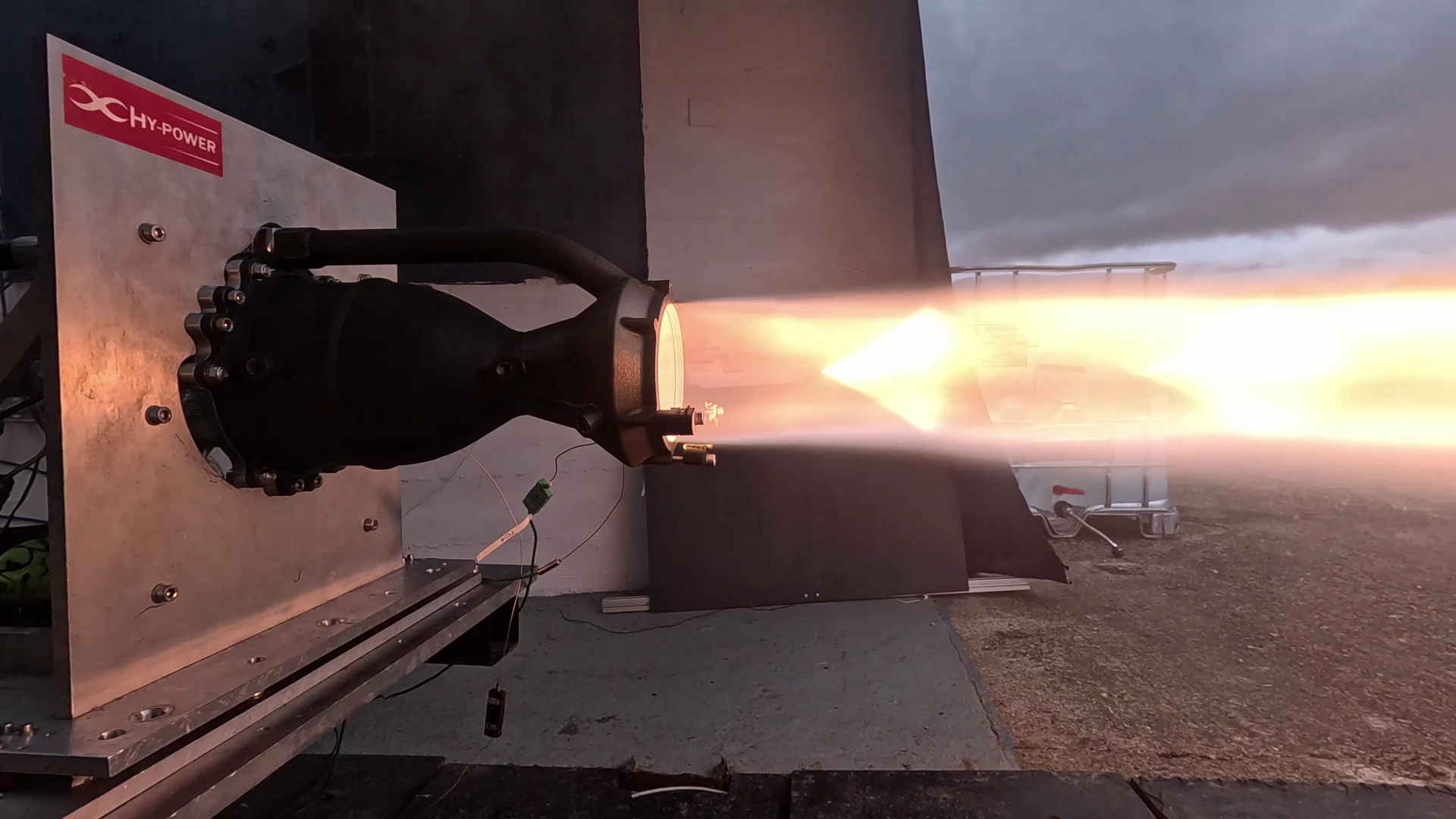
Hotfire 2, the full-duration burn. Shock diamonds hold the length of the plume.
The same burn, close on the engine.
06

Seven seconds, frame by frame

Stills from the Hotfire 2 burn in order, from the ignition sparks through the seven seconds as the evening light goes. The plume holds its shape to the end while the sky behind it goes from grey to dusk.
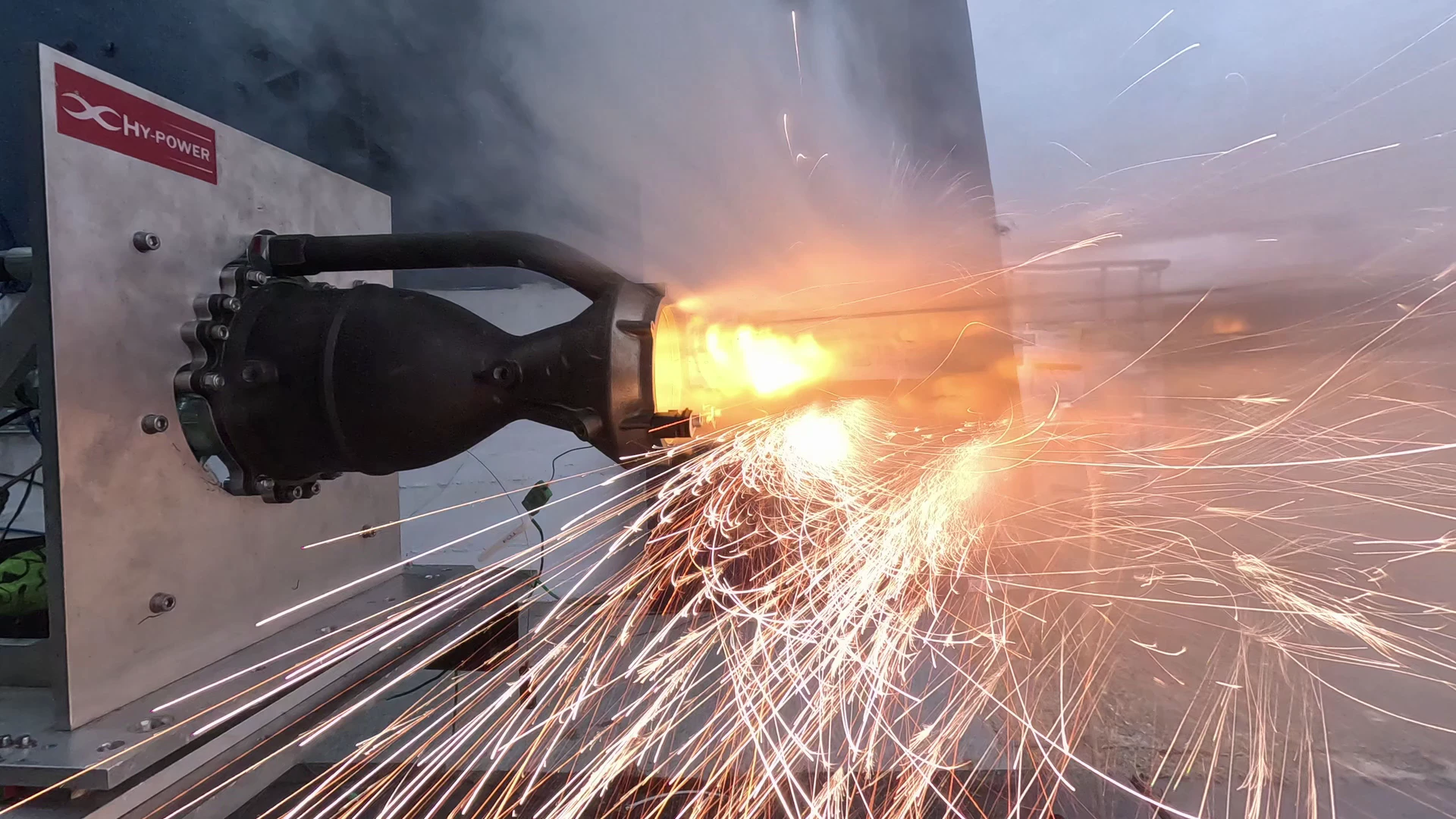
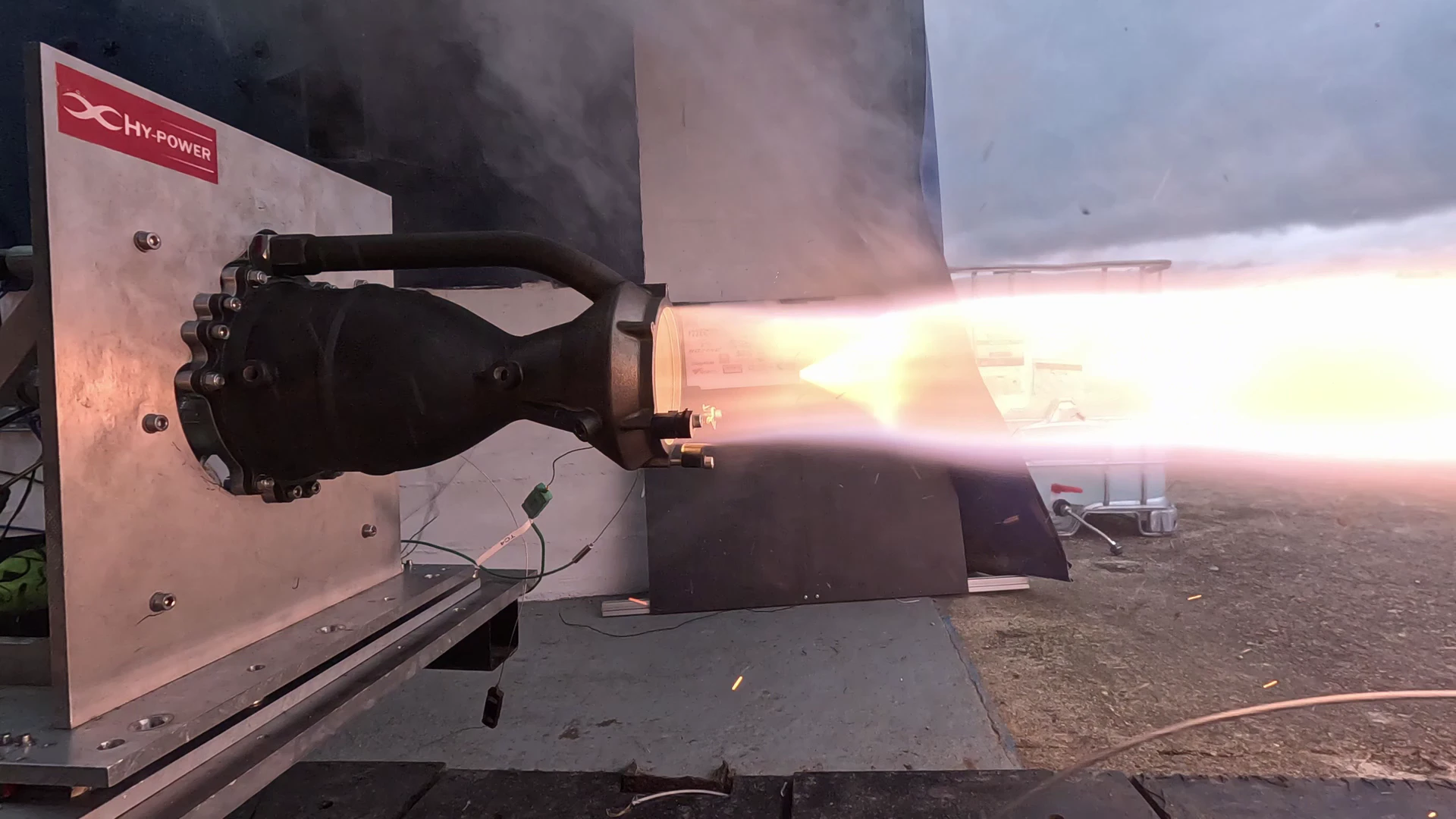
Close on the injector head and nozzle at Hotfire 2 ignition: a bright core at the throat and a fountain of sparks across the plate
Hotfire 2, close on the injector head.
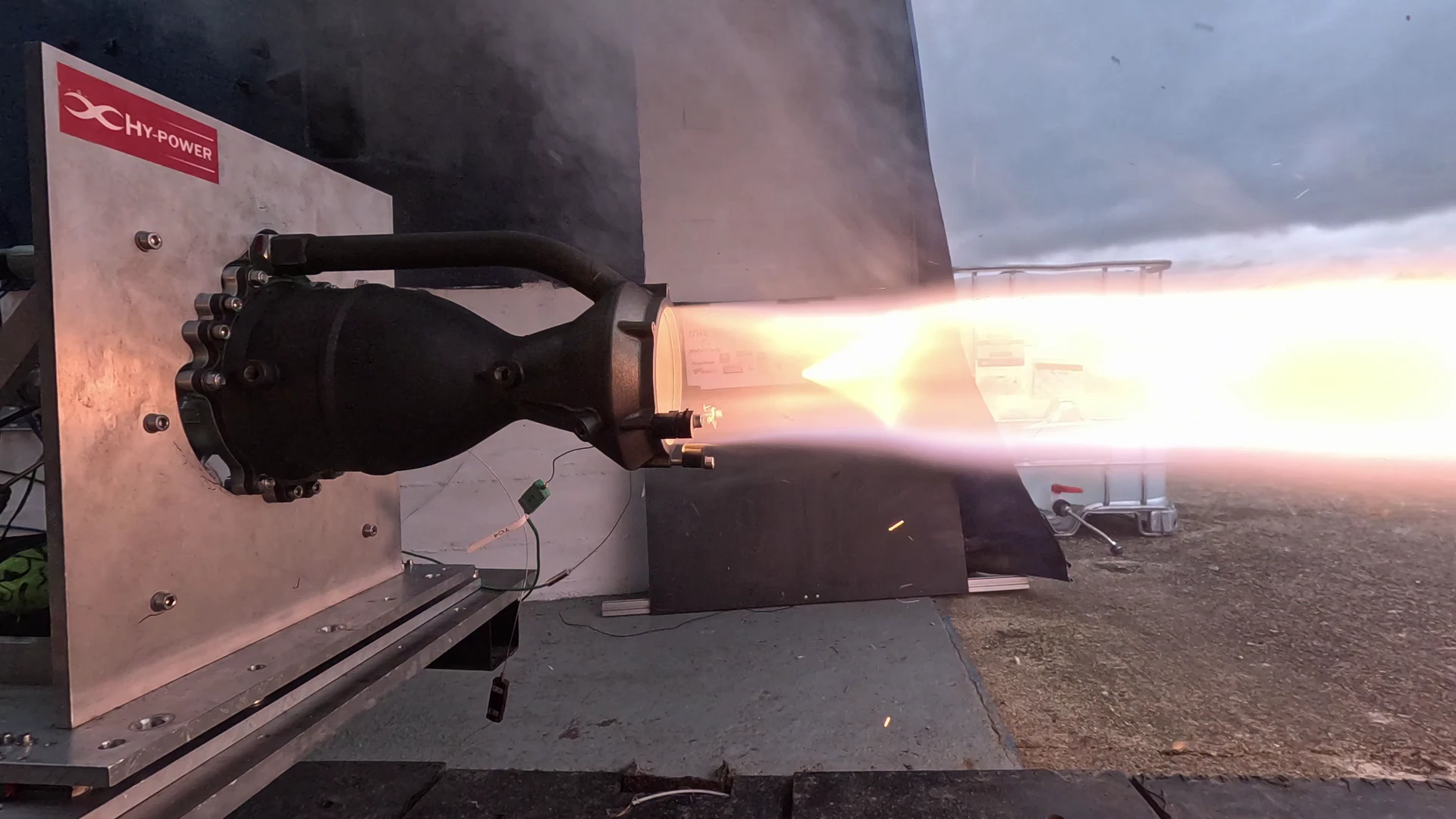
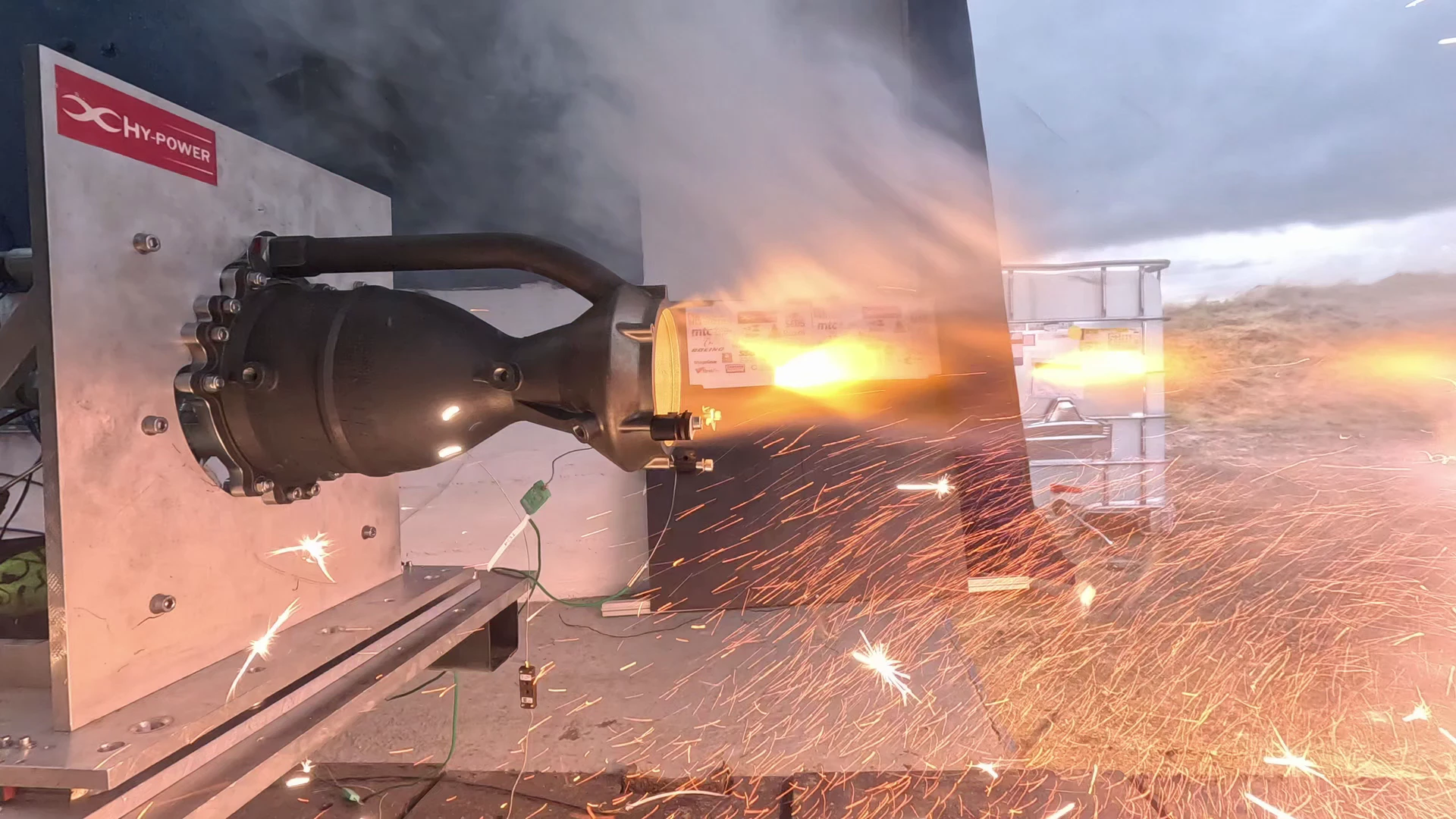
Hotfire 2 a fraction later, the plume established and sparks still flying past the oxidiser IBC behind the stand
Hotfire 2, sparks still in the air.
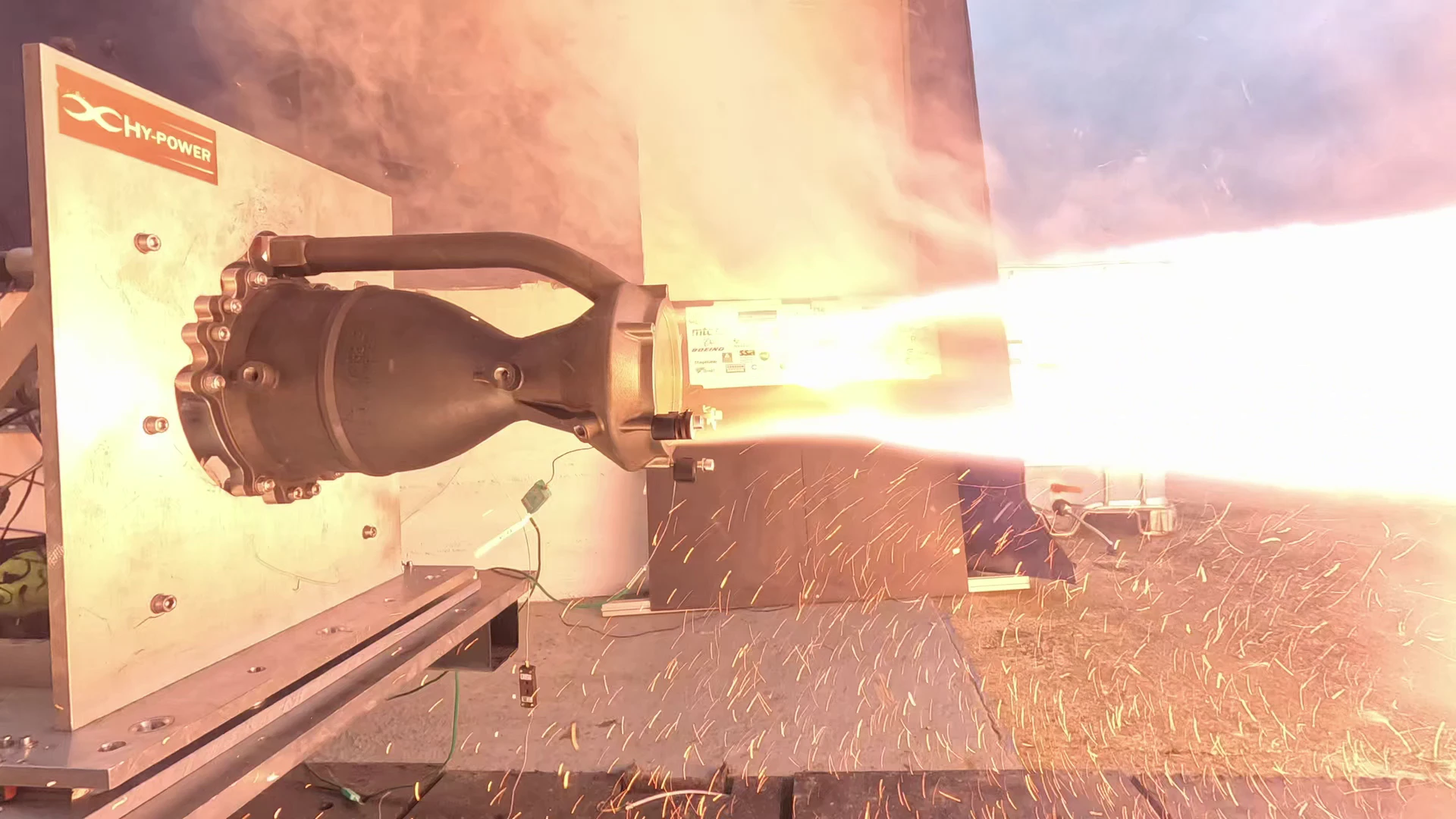
Ignition of Hotfire 2: a burst of sparks and flame at the nozzle exit with embers scattered across the pad
Hotfire 2 ignition.
Hotfire 2 just after ignition, the plume forming with smoke still rising off the pad
Hotfire 2, plume forming.
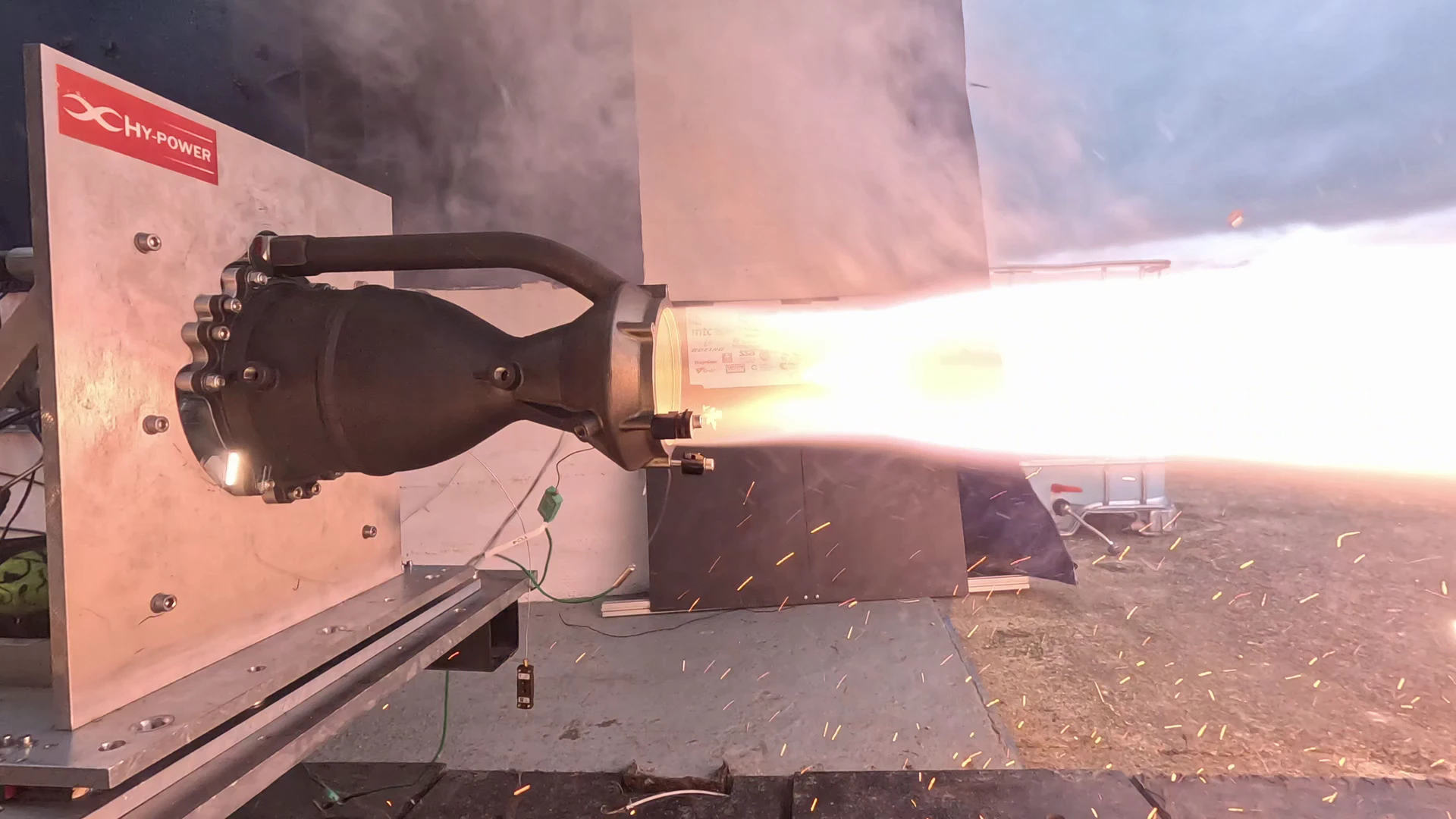
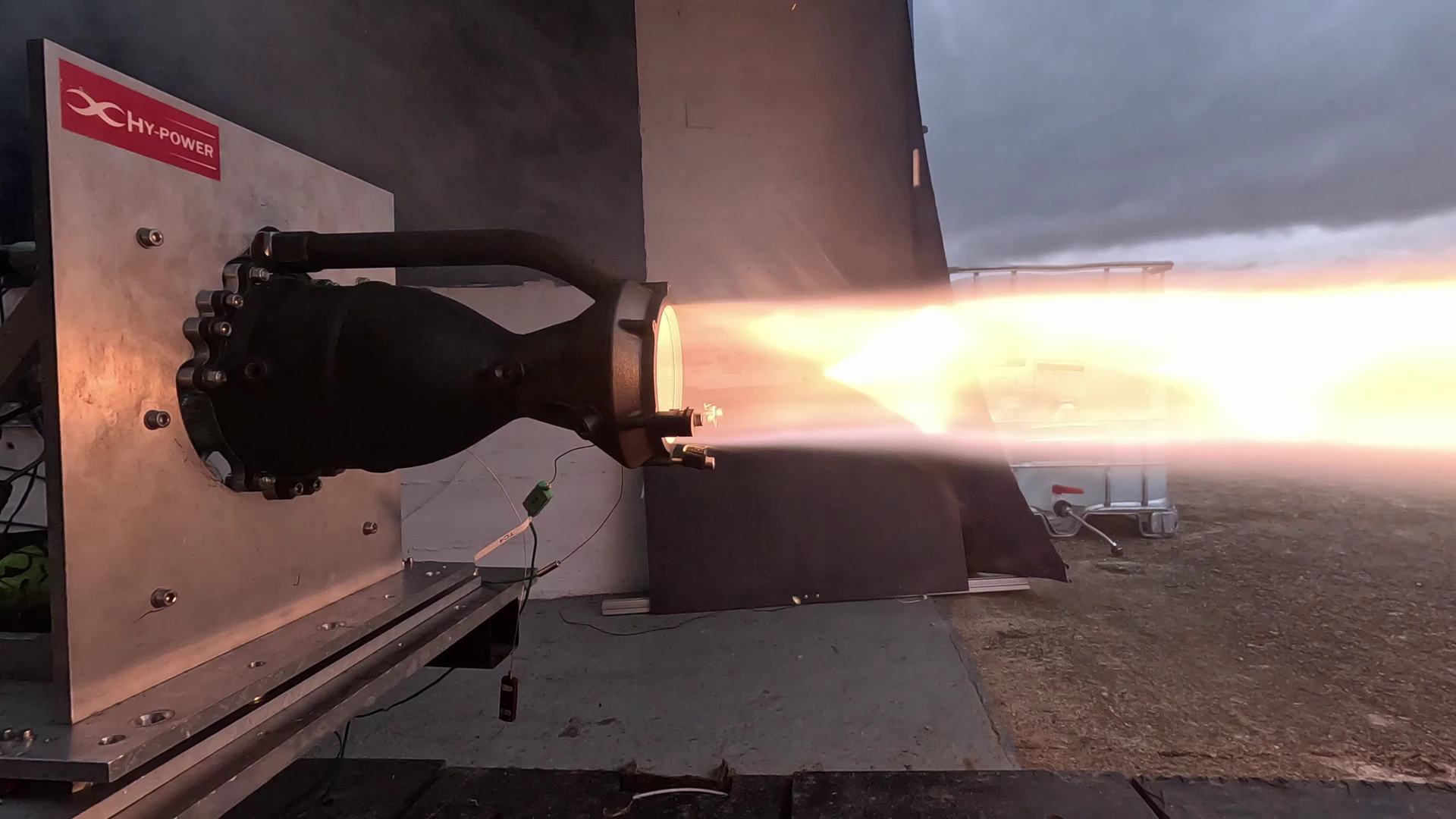
Hotfire 2 with sparks still flying, the plume bright and the sky behind it turning to dusk
Hotfire 2.
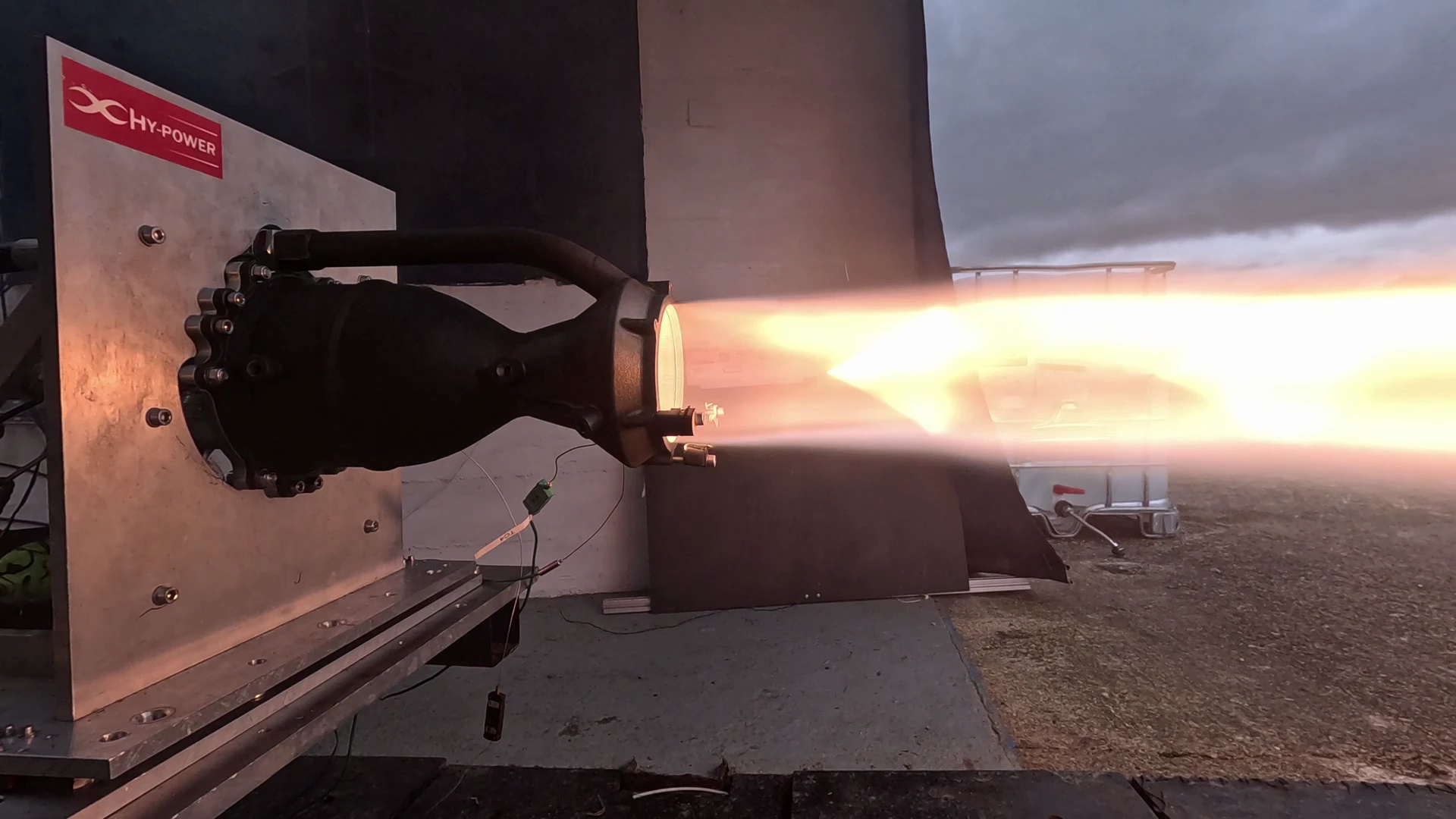
Hotfire 2 steady plume, the bright core running the length of the frame
Hotfire 2.
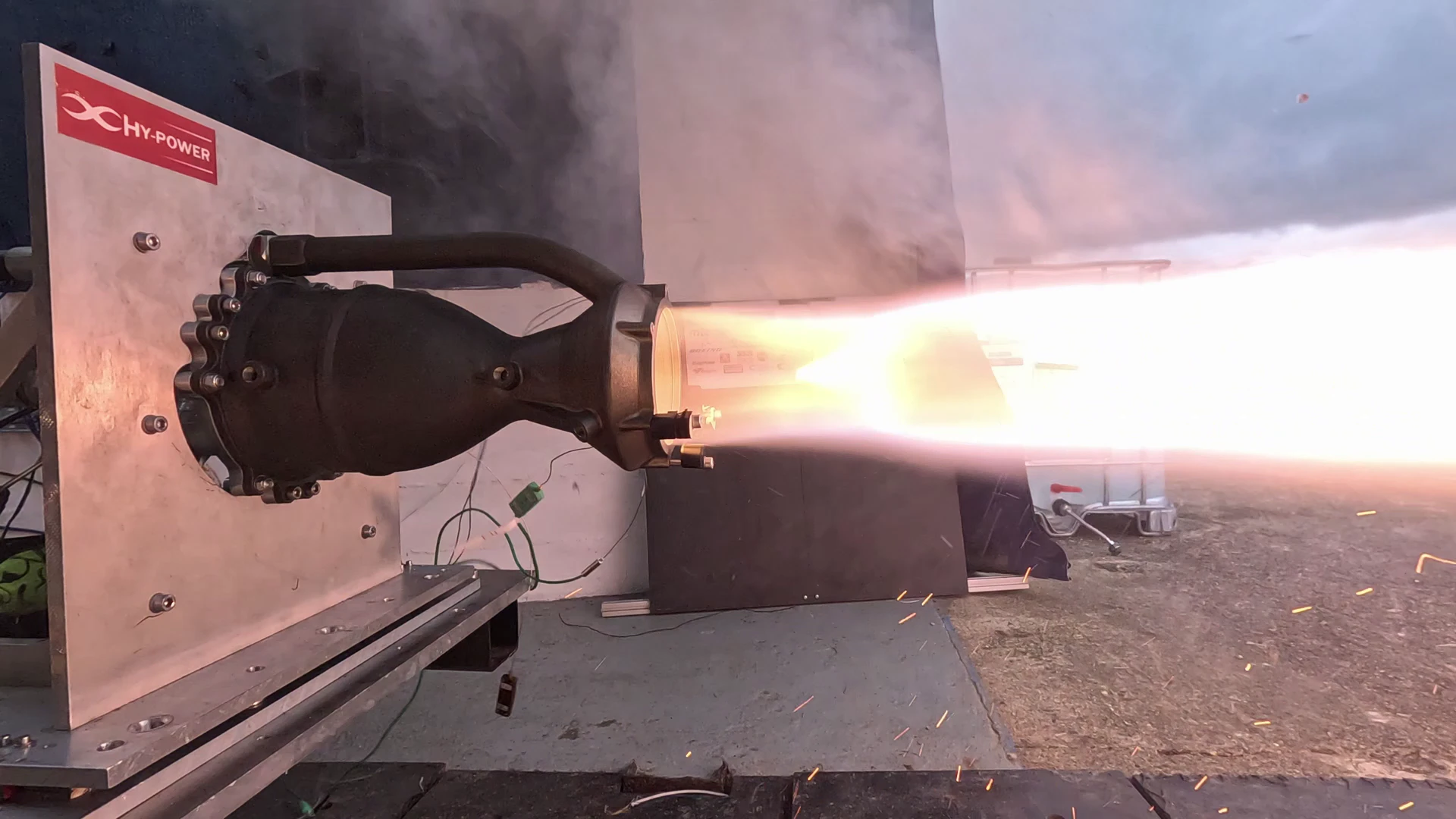
Hotfire 2 steady plume against a darkening sky
Hotfire 2.
Hotfire 2 mid-burn, the plume lighting the stand and the ground beneath it
Hotfire 2.
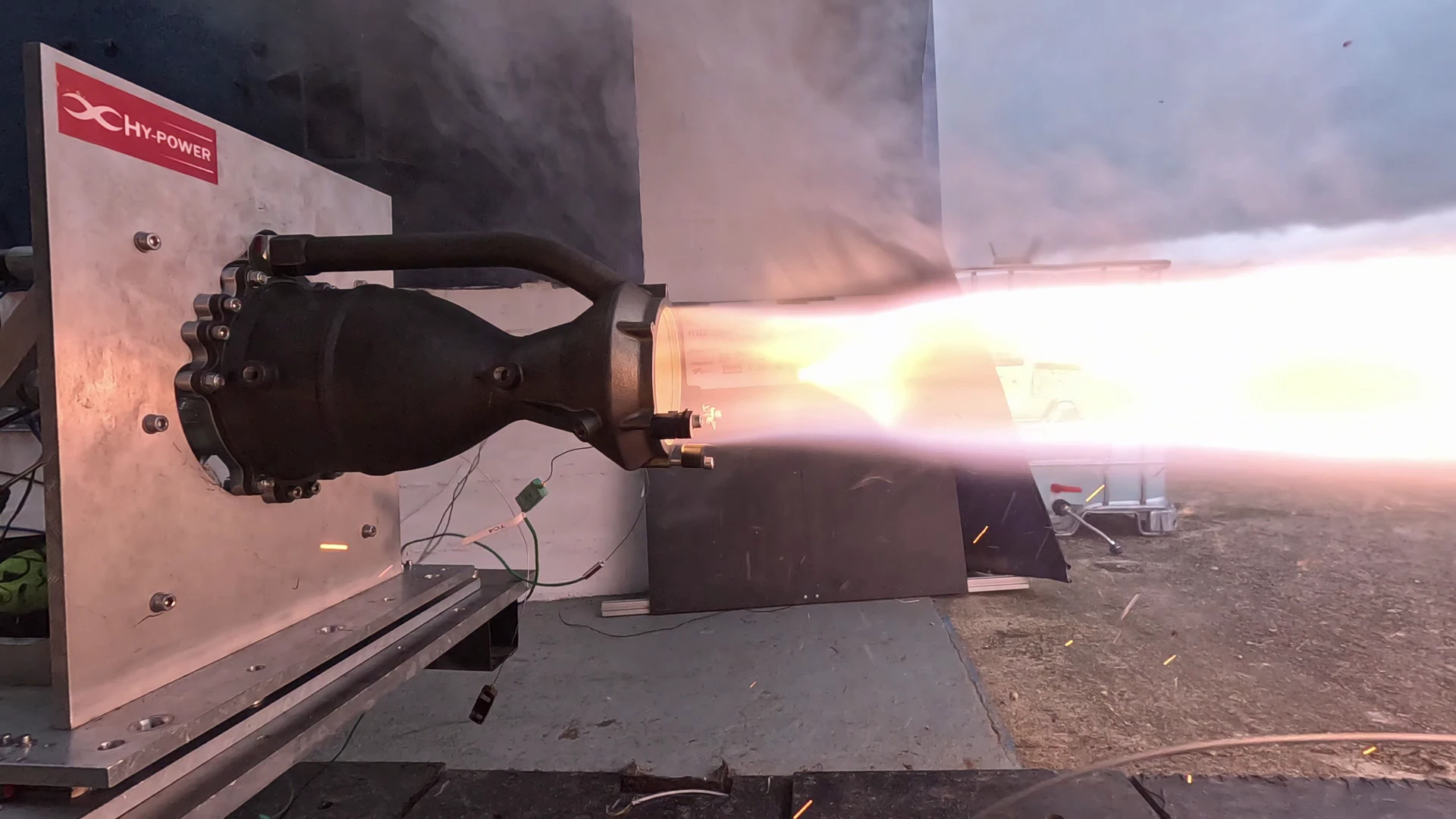
Hotfire 2 mid-burn from the same fixed camera, the bright core of the plume steady
Hotfire 2.
Engine 1 firing horizontally on the Astron test stand at dusk, a long golden plume with a bright shock core against a grey evening sky
Hotfire 2, full duration. Astron Systems, September 2025.
Hotfire 2 late in the burn, the plume still full against the evening sky
Hotfire 2.
Hotfire 2 near the end of the seven-second burn, the plume orange against the dusk
Hotfire 2, towards shutdown.
07

Hotfire 3: 5.58 kN

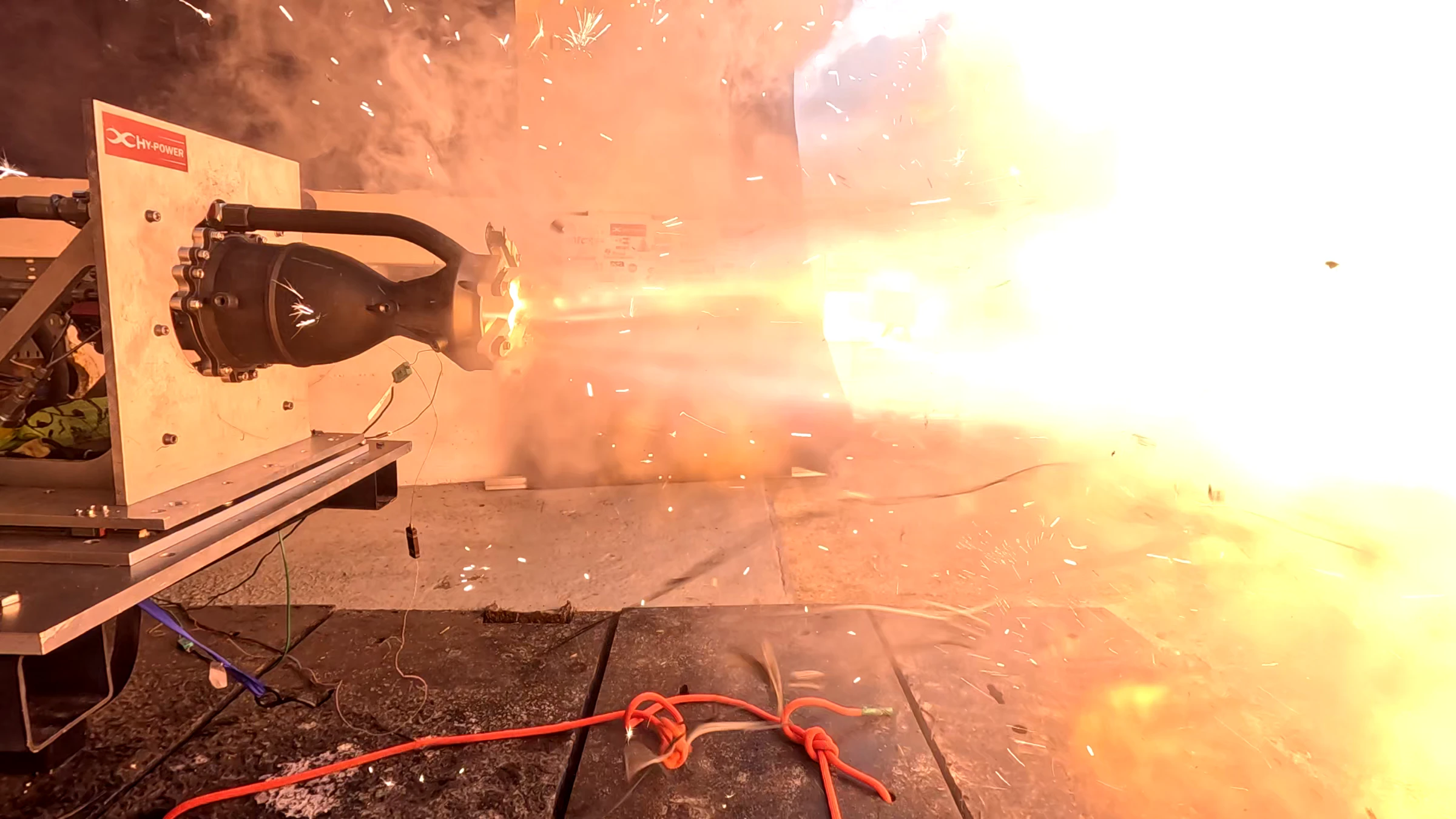
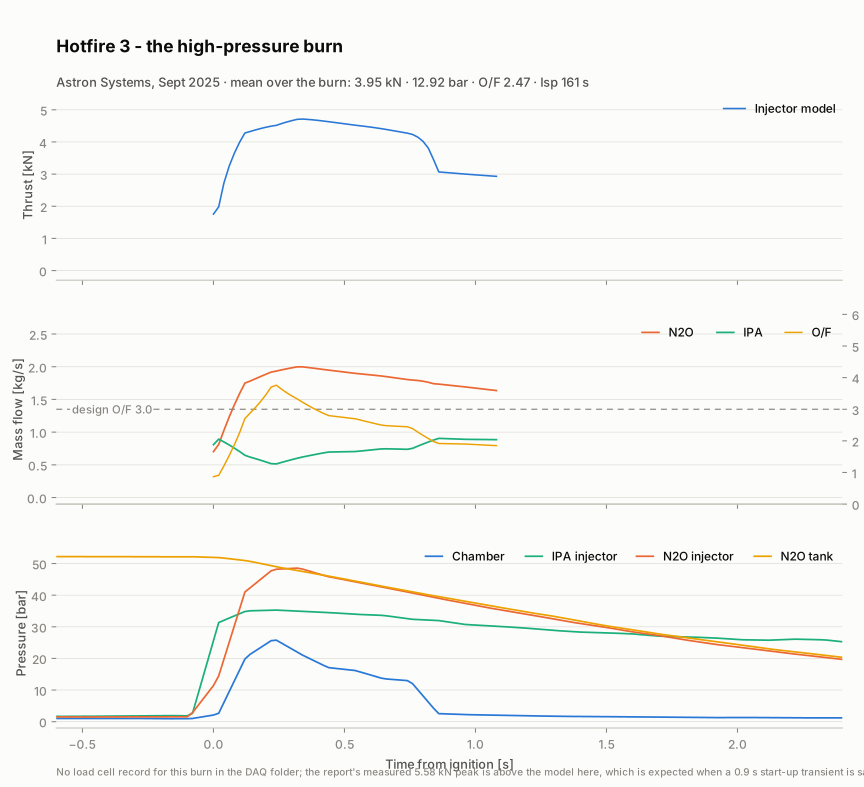
For the last burn we took the regulator up to 50 bar. Another partial fill, so it ran only 0.86 s, but it peaked at 5.58 kN, the highest thrust the stack produced all week, and it lit the whole cell. On that thrust the off-rail speed comes out at 34.9 m/s. The nitrous tank shows 52 bar at the count and chamber pressure spikes to 25.8 bar, well past the 20 bar design point, before the part-filled tank runs out from under it.
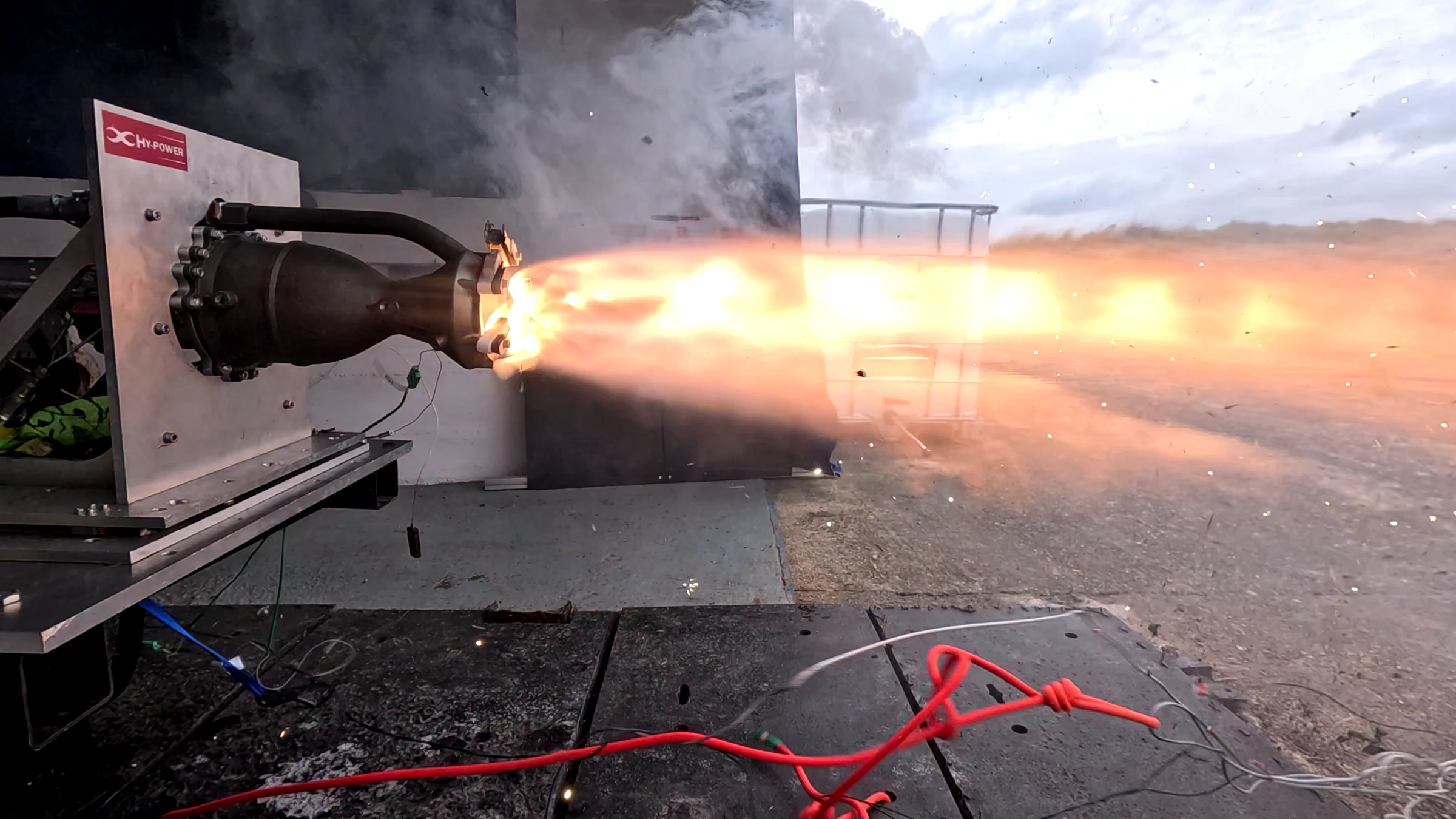
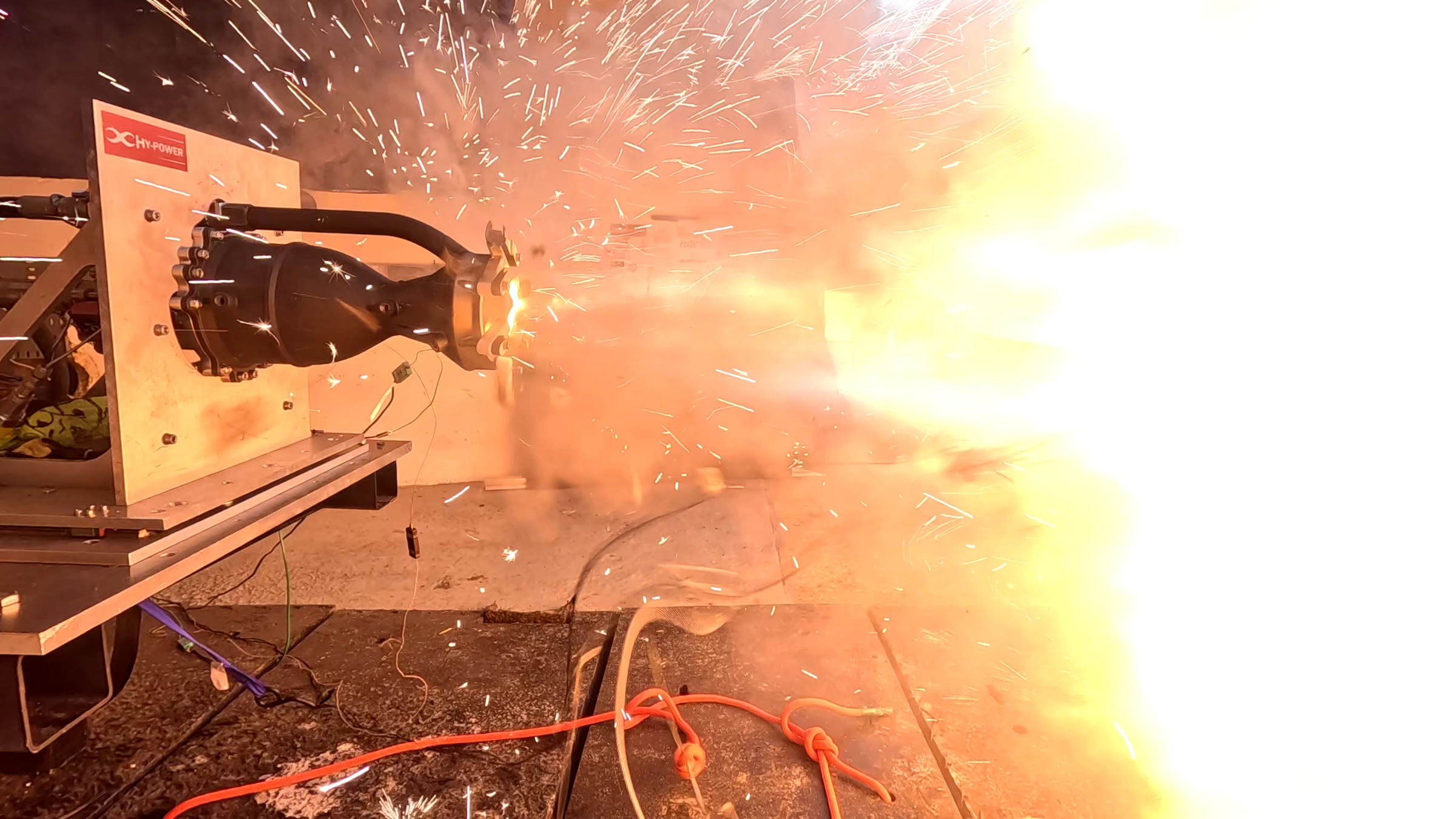
Hotfire 3 at full chamber pressure: a dense plume with a clear shock train leaving the nozzle, the ground dark and the sky pale behind it
Hotfire 3. The highest chamber pressure of the week, 25.8 bar.
Hotfire 3 with the plume flooding the right of the frame in orange, sparks thrown across the dark ground
Hotfire 3, a second of it.
Hotfire 3, the plume washing out the frame, the engine and stand in silhouette
Hotfire 3.
Hotfire 3 ignition: a burst of sparks at the nozzle against a dark test pad, red hose coiled in the foreground
Hotfire 3, ignition.
08

Measured, not just modelled

The stand gave us two independent records of the same burn: a load cell on the thrust structure, and ten pressure transducers on a Raspberry Pi. Feeding the measured injector pressure drops through an orifice model, incompressible on the IPA side and a Dyer non-homogeneous blend on the nitrous side, reproduces the load cell to within 3% at the peak and 8% on the mean, and puts the mixture ratio at 3.08 against a design 3.0. Two methods, one answer, which is the only reason to trust either. The load-cell log in the DAQ folder covers Hotfire 2 only; Hotfire 3's 5.58 kN is the report's own load-cell figure, and the model reads under it, which is what a 0.9 s start-up sampled at 10 Hz will do.
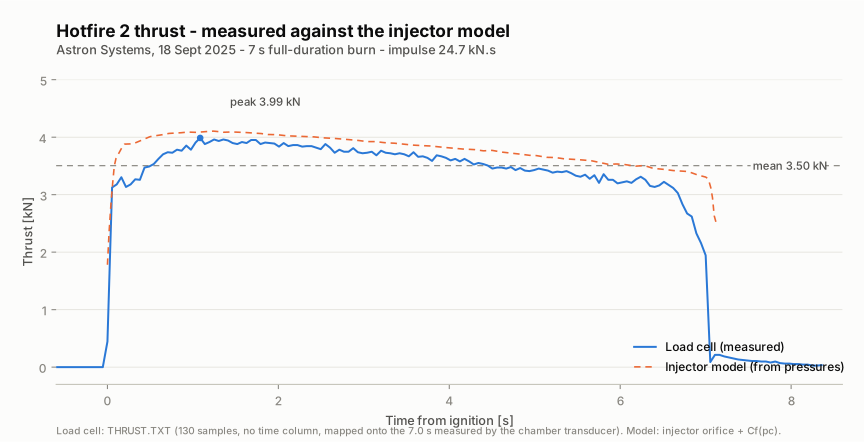
Line chart of Hotfire 2 thrust against time from ignition. The measured load cell trace rises to a 3.99 kN peak about a second in, then decays steadily to 3.0 kN before a hard cutoff at 7 s. The dashed injector model runs 0.1 to 0.3 kN above it throughout.
Hotfire 2 thrust: load cell against the injector model. Peak 3.99 kN, mean 3.50 kN, impulse 24.7 kN.s.
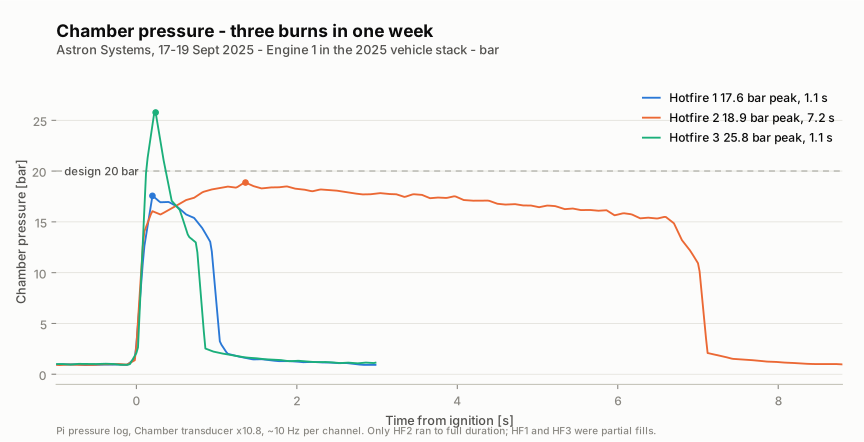
Line chart of chamber pressure against time from ignition for all three burns. Hotfire 3 spikes to 25.8 bar and dies inside 1.1 s, Hotfire 1 holds 17.6 bar for 1.1 s, Hotfire 2 sits between 18.9 and 15.5 bar for 7.2 s. A dashed line marks the 20 bar design point.
Chamber pressure for all three burns, aligned at ignition. Design point 20 bar.
09

Every channel, second by second

Hotfire 2 and Hotfire 3 in full: thrust, propellant mass flows, mixture ratio, and the injector and tank pressures behind them. The shape of the week is in the bottom panels, a nitrous tank blowing down from 42 bar over seven seconds on one burn and from 52 bar in under one on the other.
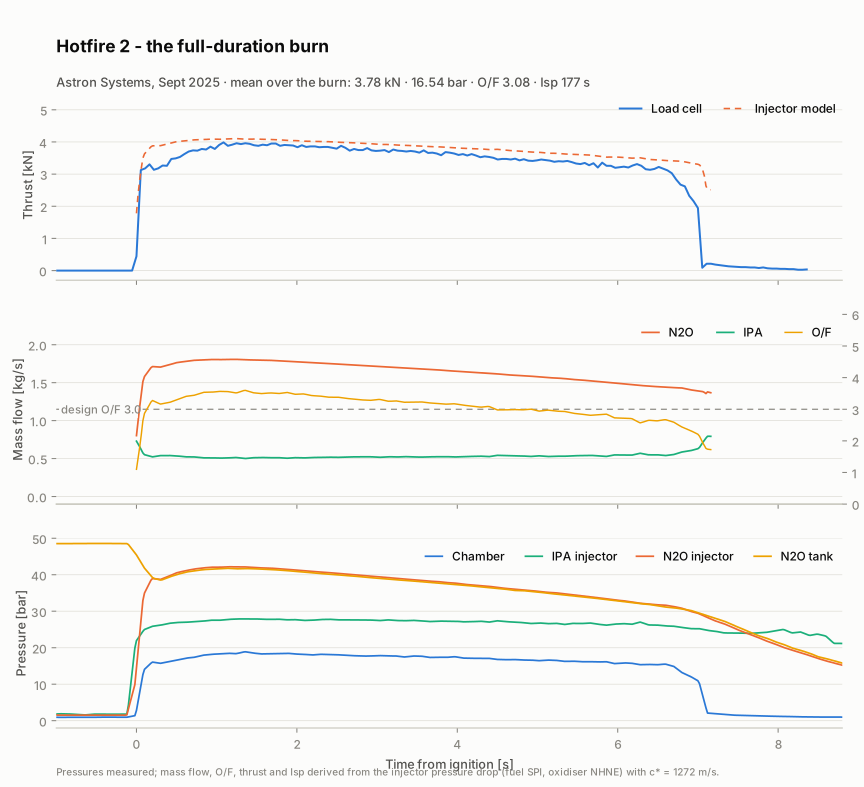
Three stacked charts for Hotfire 2: measured and modelled thrust; nitrous and IPA mass flow with the O/F ratio on a second axis, holding just above the 3.0 design point; and chamber, injector and tank pressures showing the nitrous tank blowing down from 42 bar.
Hotfire 2, every channel: thrust, mass flow and mixture ratio, feed and tank pressures.
Three stacked charts for Hotfire 3: modelled thrust peaking near 4.7 kN, mass flow and O/F, and pressures showing chamber pressure spiking to 25.8 bar while the nitrous tank falls away from 52 bar.
Hotfire 3: chamber pressure spikes to 25.8 bar, then the part-filled tank runs out.
10

Five cameras on one week

The bay was covered from inside and out: a fisheye at the back wall looking downrange, a camera at ground level across the gravel, two close on the engine, and a wide from outside. Between attempts the engine vents nitrous, cold and silent, which is most of what a test week actually looks like.

From inside the bay, looking downrange.
Ground level, outside the bay.
Every camera on the stand, cut together.
Venting nitrous between attempts. No flame, just cold gas.
11

The week, cut together

The team's own edit of the campaign, every angle in order.

The week, cut together by the team.
Related