Ethan Sheehan
All work — 2023

Engineering by Design

EWB Challenge for a Cambodian village: a 50-drone delivery fleet chosen by weighted pairwise comparison, and a week-7 pencil study of a Merlin 1-D.
RoleGroup challenge and individual portfolio
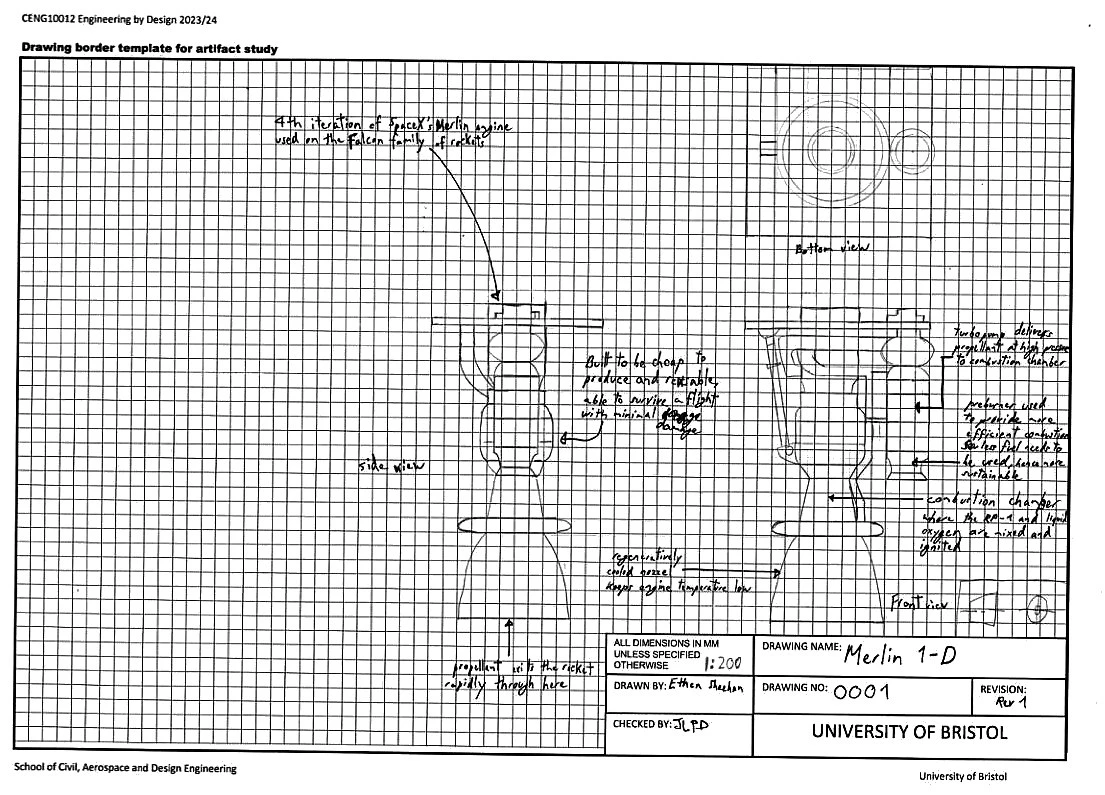
Hand-drawn artefact study on grid paper of a SpaceX Merlin 1-D: side, front and bottom views annotated for the turbopump, preburner, combustion chamber and regeneratively cooled nozzle, in a University of Bristol title block
Artefact study, week 7, November 2023. Drawing no. 0001 Rev 1, 1:200.
Options weighed
5
Winning score
3.18
Fleet
50 drones
01

The EWB challenge

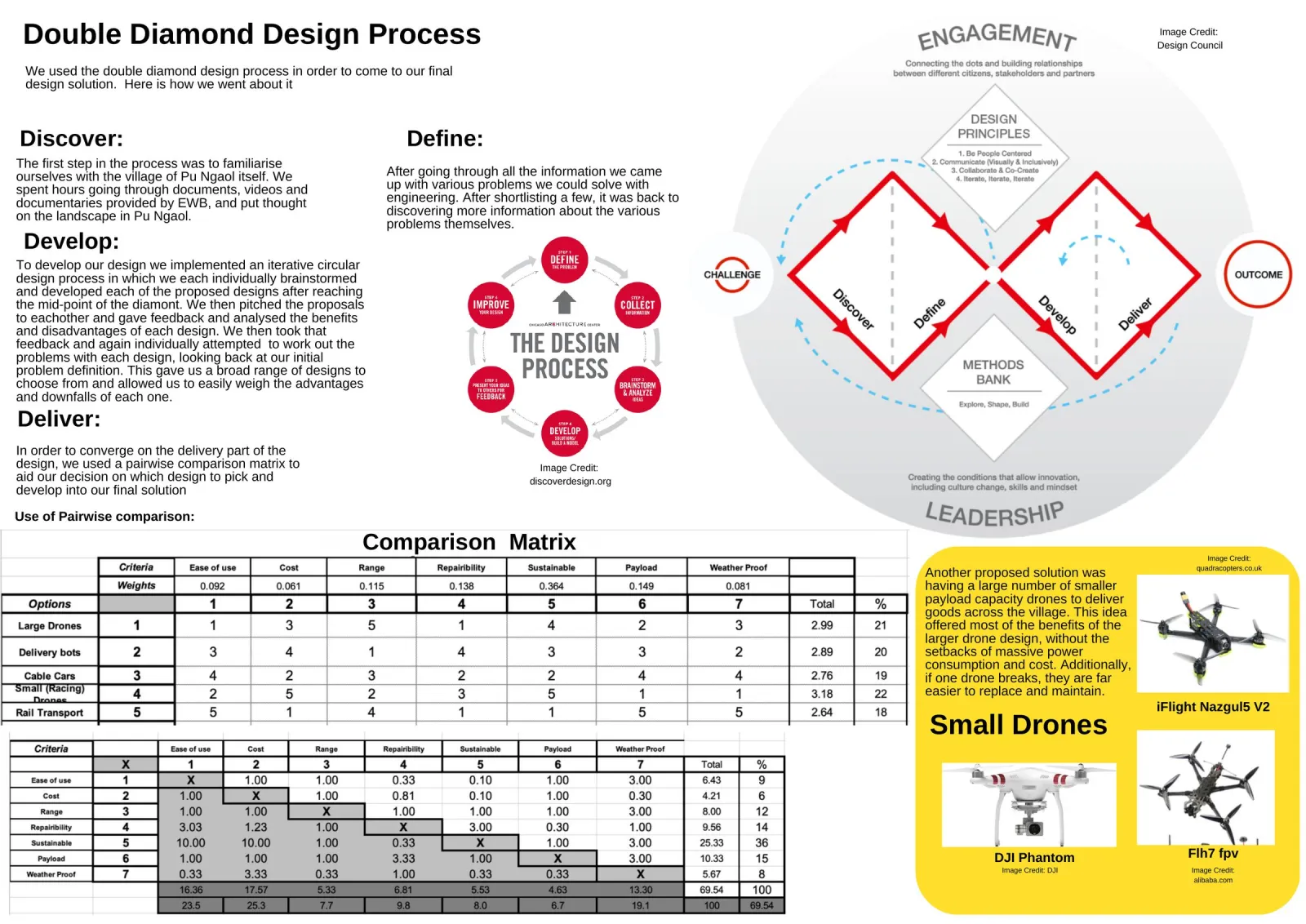
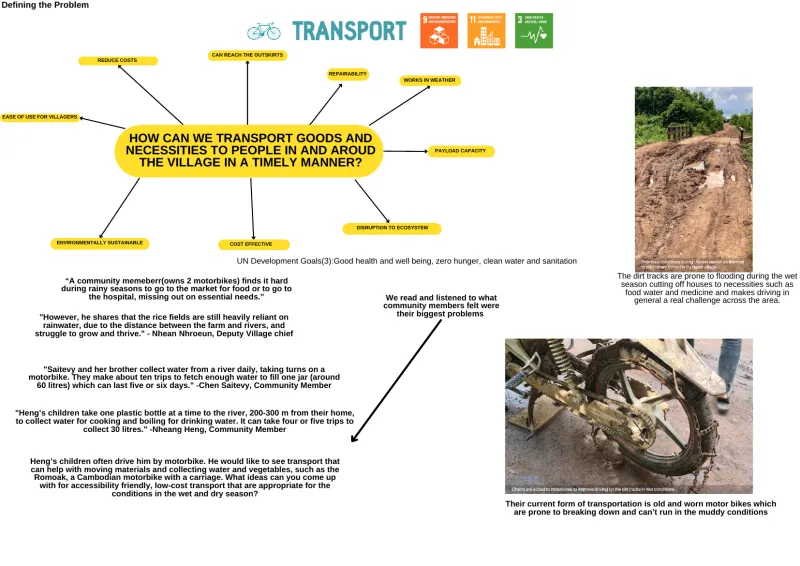
The group half of the Year 1 design unit was the Engineers Without Borders brief for Pu Ngaol, a village in Cambodia. In the wet season the dirt tracks flood and cut houses off from food, water and medicine; one family makes about ten motorbike trips to fill a 60 L water jar. We bounded the question to wet-season transport of goods and set criteria: cost, reach to the outskirts, repairability, weather, ease of use, payload, ecosystem disruption, sustainability. Then a Double Diamond: each of us worked up an option, pitched it, took feedback, went round again. Five options reached a weighted pairwise comparison matrix. Four-page A3 poster, presented 7 December 2023.
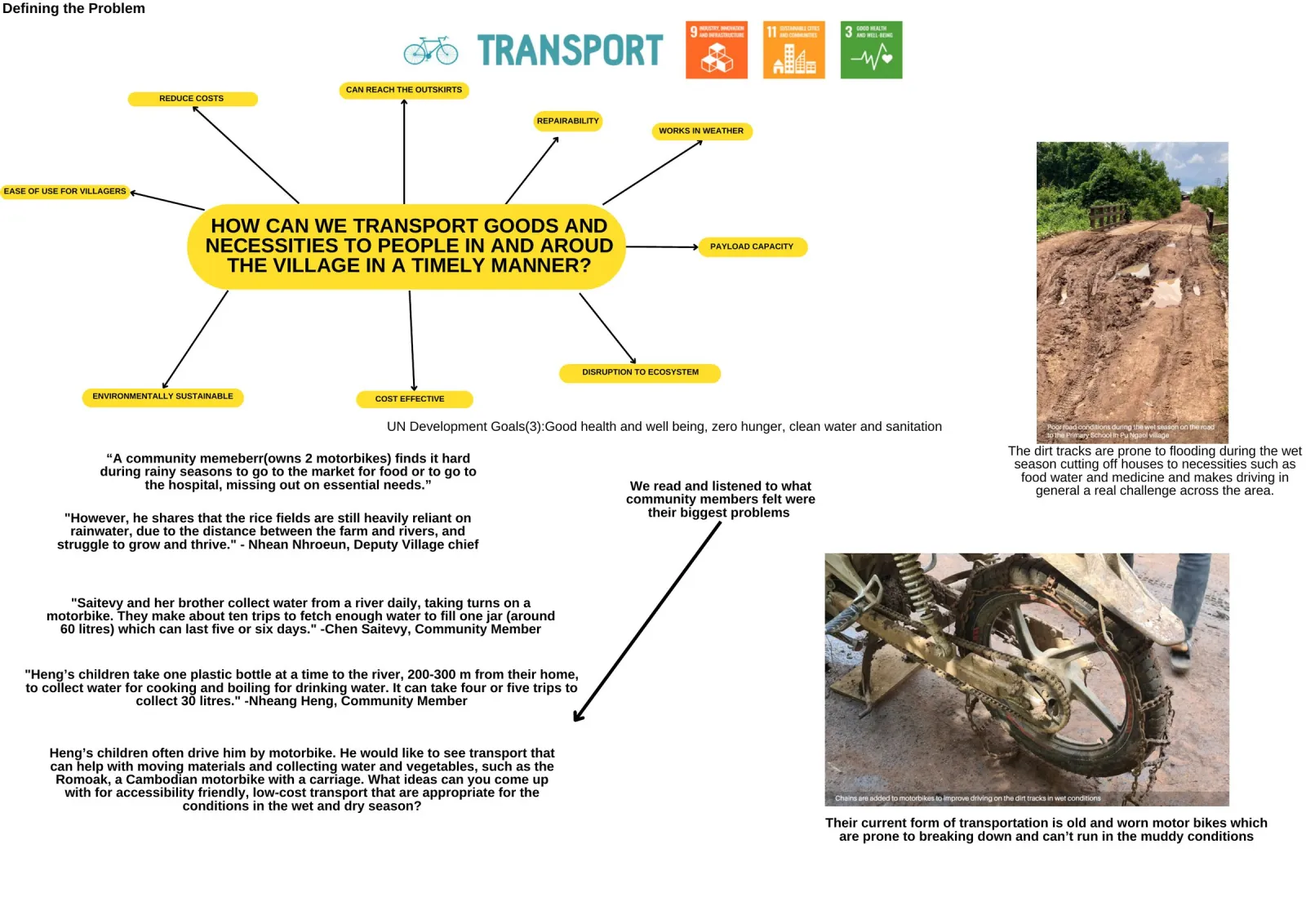
Poster page one: the team's question in a yellow bubble with eight criteria radiating from it, community quotes, UN SDG icons, and photographs of a flooded dirt track and a chained motorbike tyre
Page 1, defining the problem. Photographs from the EWB pack.
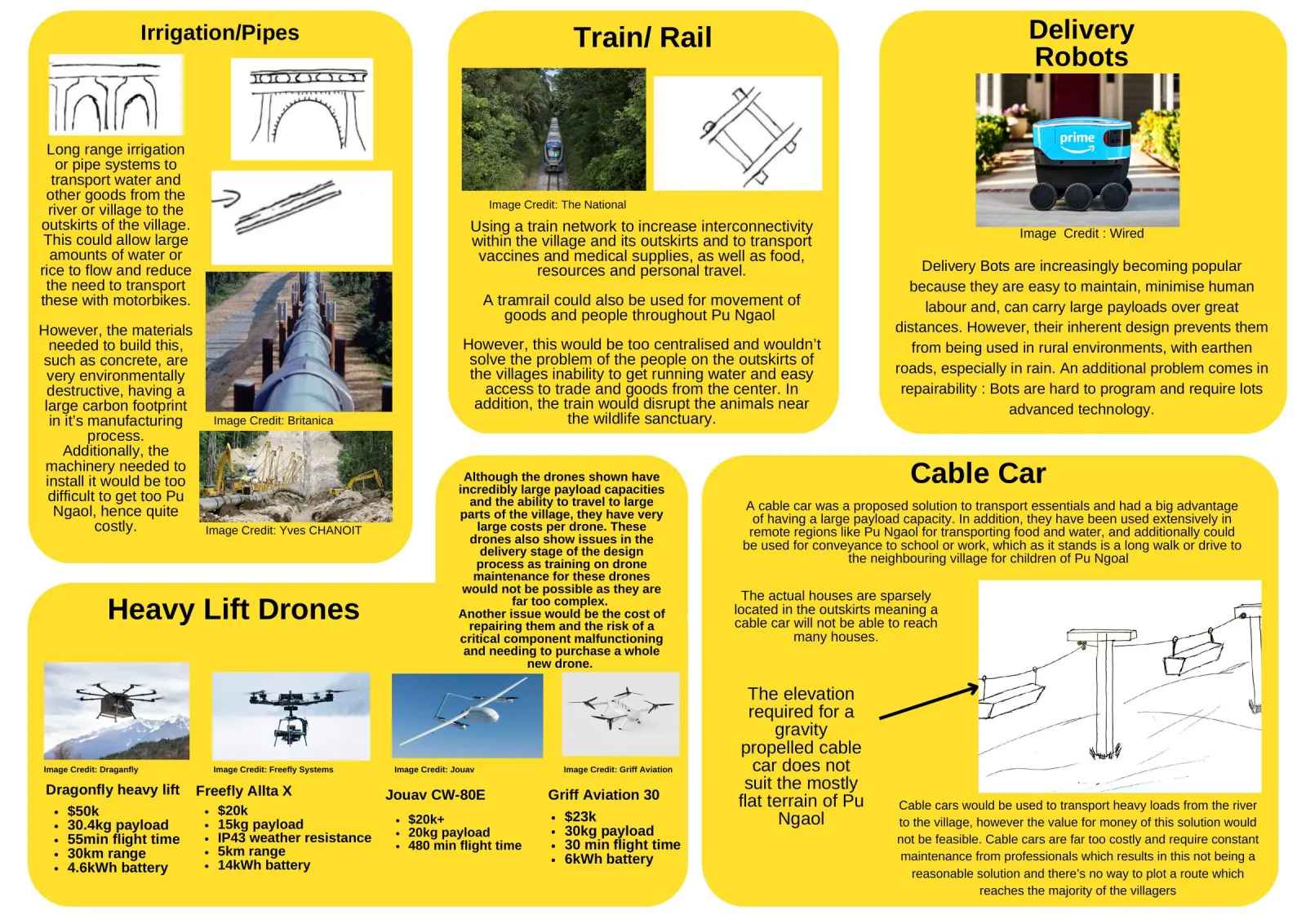
Poster page two: yellow panels for irrigation pipes, train or rail, delivery robots, heavy-lift drones with a four-model spec table, and a cable car, each with its rejection reasoning
Page 2, five alternatives and why each fell short.
Poster page three: Double Diamond narrative beside the Design Council diagram, both pairwise comparison matrices, and a small-drones panel
Page 3, Double Diamond and the pairwise comparison.
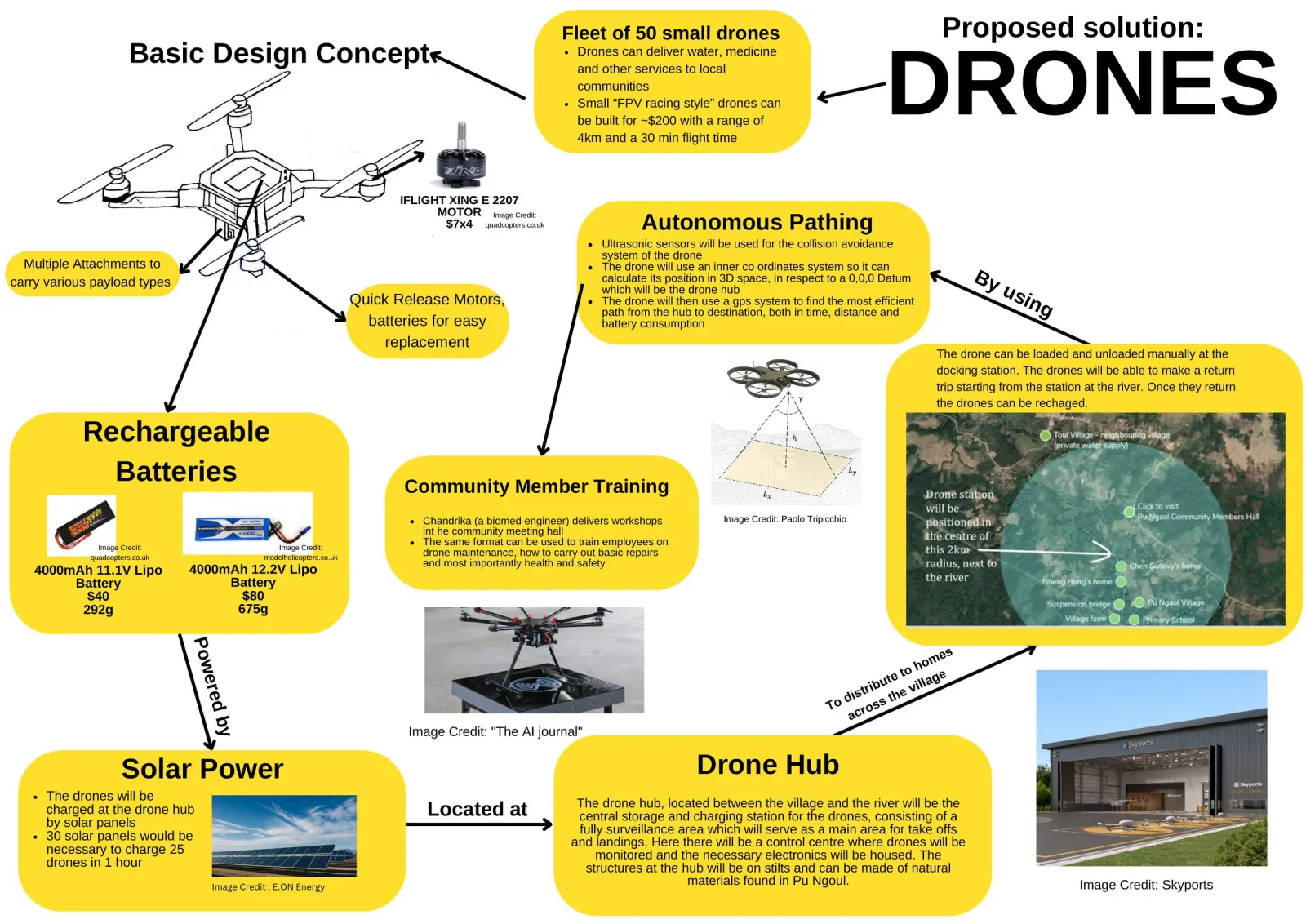
Poster page four: the drone concept board with the hand-drawn quad, motor and battery specs, autonomous pathing, community training, solar power, the drone hub, and a 2 km radius drawn on a satellite map
Page 4, the proposed solution: a fleet of 50 small drones.
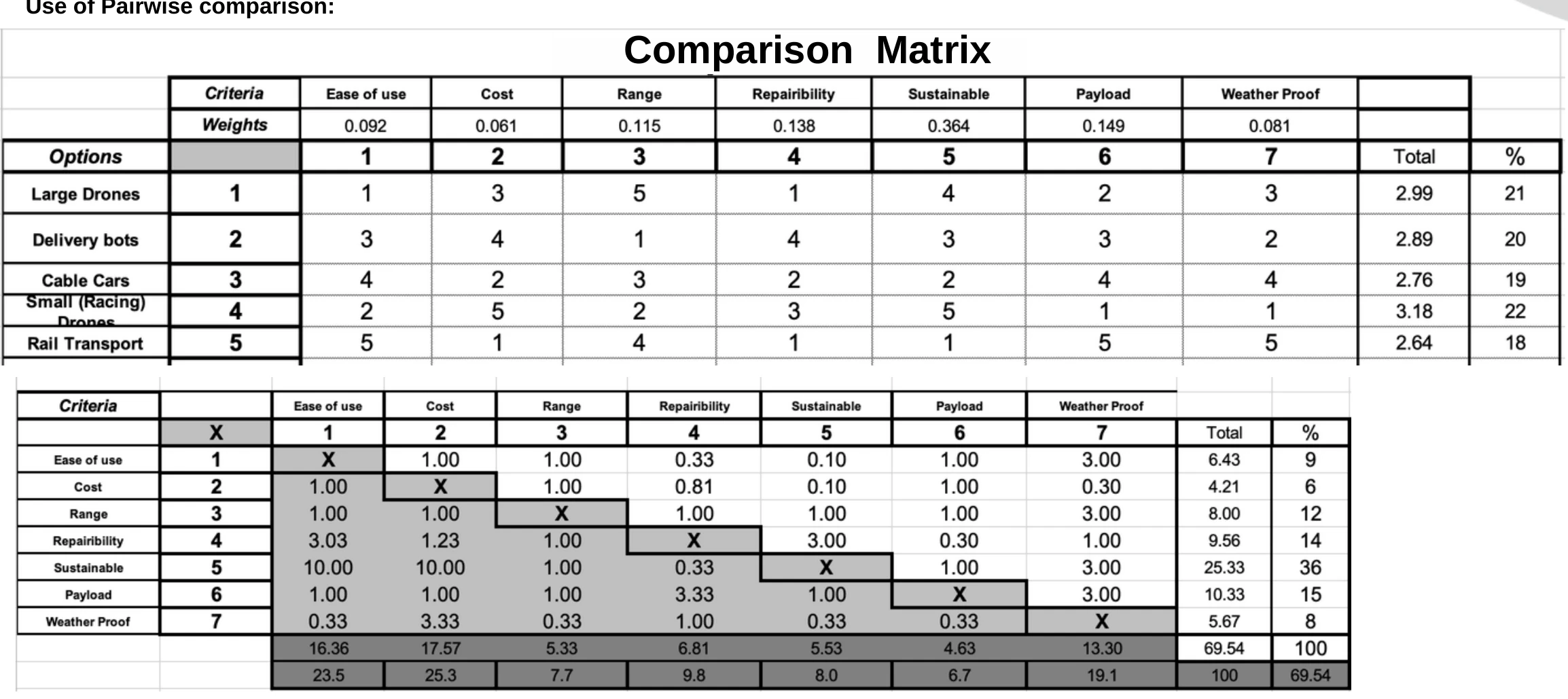
Two tables: the option scoring matrix with weighted totals, small racing drones highest at 3.18, and below it the criteria-weighting matrix with Sustainable at 36 percent
Five options against seven weighted criteria; the weights came from pairing the criteria against each other.
02

Fifty small drones

Small FPV-racing-style drones scored 3.18 against 2.99 for heavy-lift drones, with delivery robots, cable cars and rail behind. Sustainability carried the largest weight, 0.364, and a heavy-lift drone costs $20-50k each; a racing-class quad is about $200, flies about 4 km and about 30 minutes. So: a fleet of 50, quick-release motors and batteries so villagers can repair them, a hub on stilts between the village and the river serving a 2 km radius, solar charging, autonomous routing with the hub as datum. My part was the research on the existing drones the design was based on and the cost case for the small-drone route, then writing and formatting the final poster from the team's contributions.
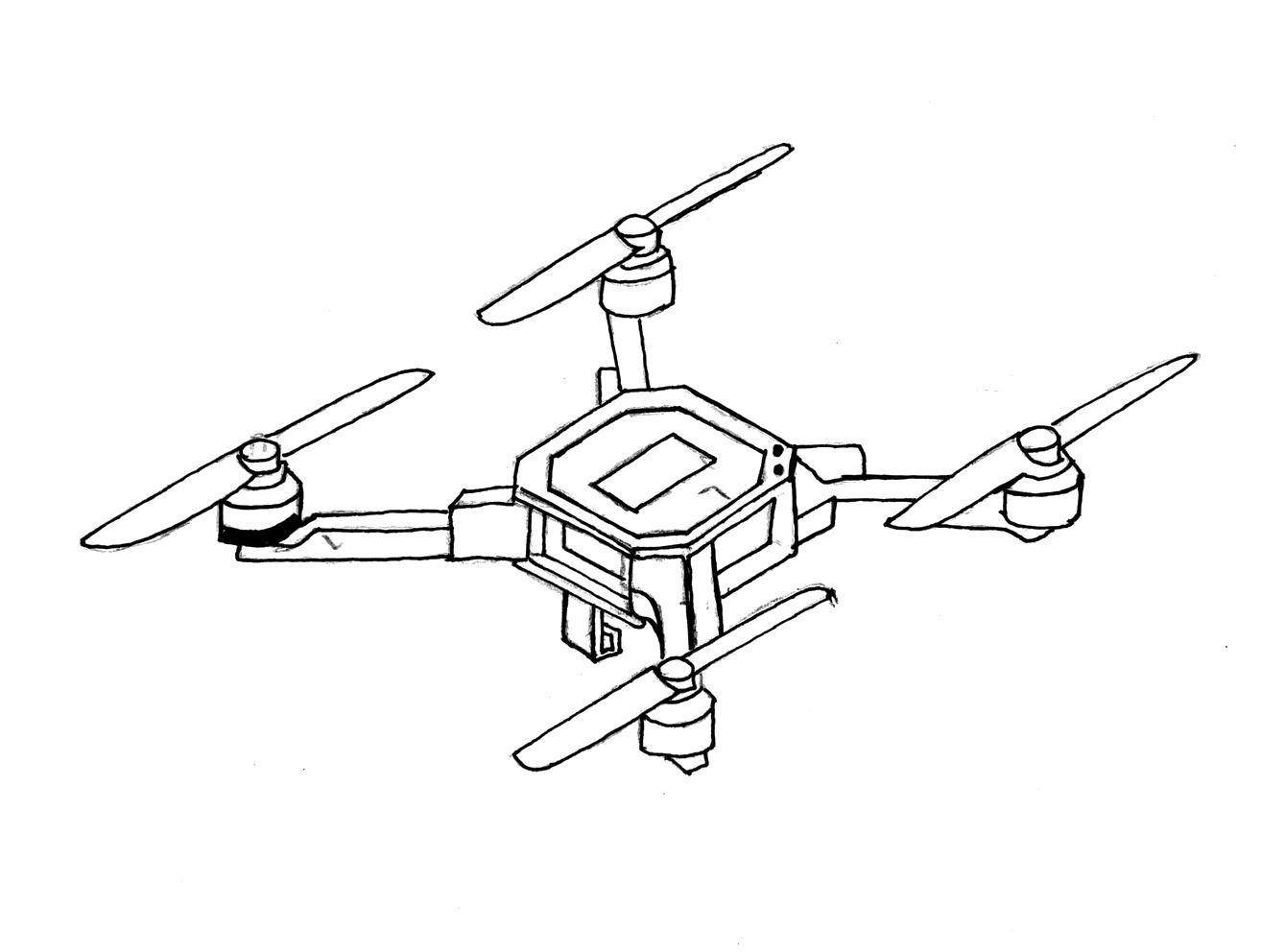
Line drawing of a quadcopter with a hexagonal body, four arms carrying motors and two-blade propellers, and a payload clip underneath
The team's delivery-drone concept, from poster page 4.
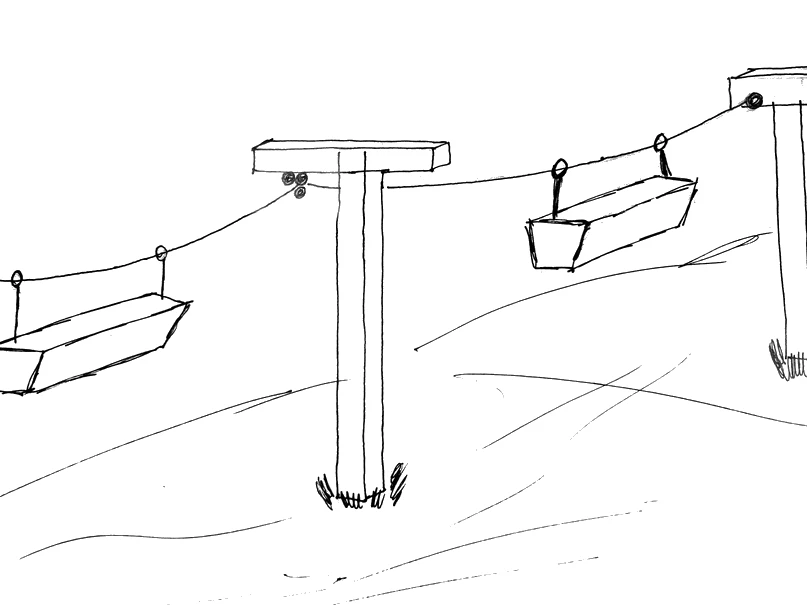
Hand-drawn sketch of a cable car line: two pylons with open gondola buckets hanging from the cable over rolling ground
The cable-car alternative, from poster page 2. Scored 2.76.
03

Drawing

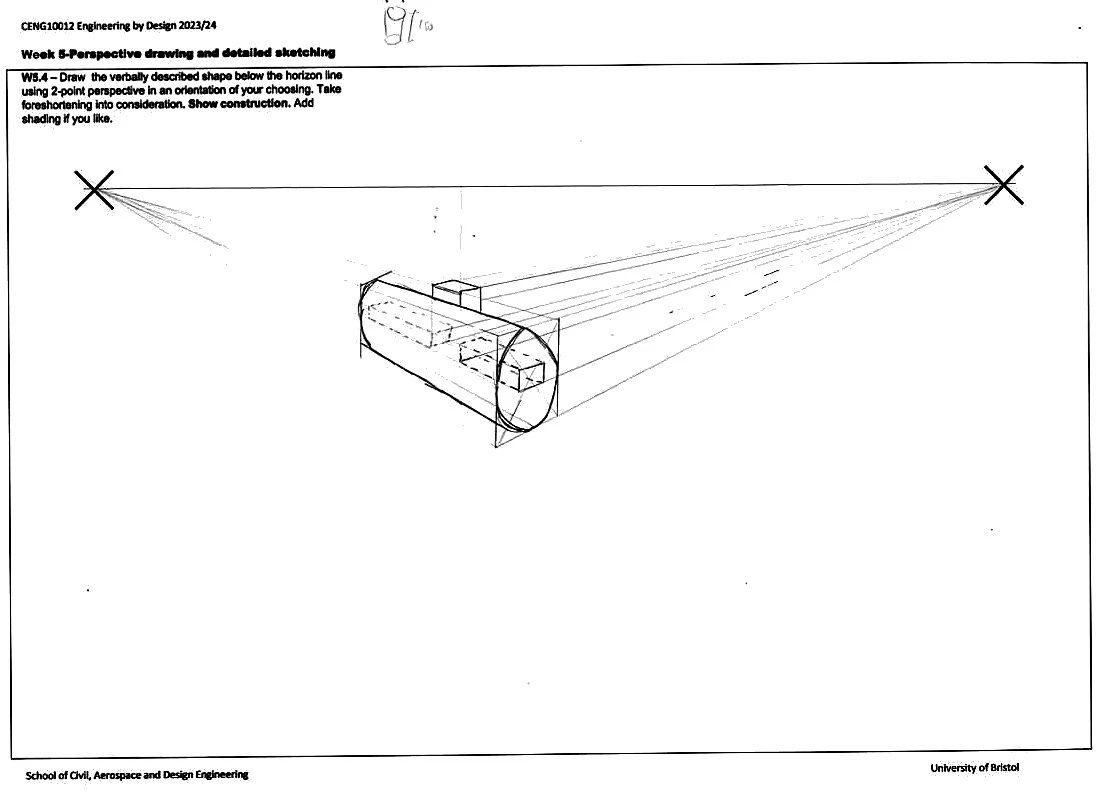
The individual portfolio opened with three hand-drawing exercises on grid paper. Week 3: top, front and side views of a verbally described part, with dimensions and a projection-symbol box. Week 4: an isometric view with a quarter-section, on isometric grid. Week 5: a two-point perspective with the construction lines left in to both vanishing points. Honest first-year pencil work, shown small.
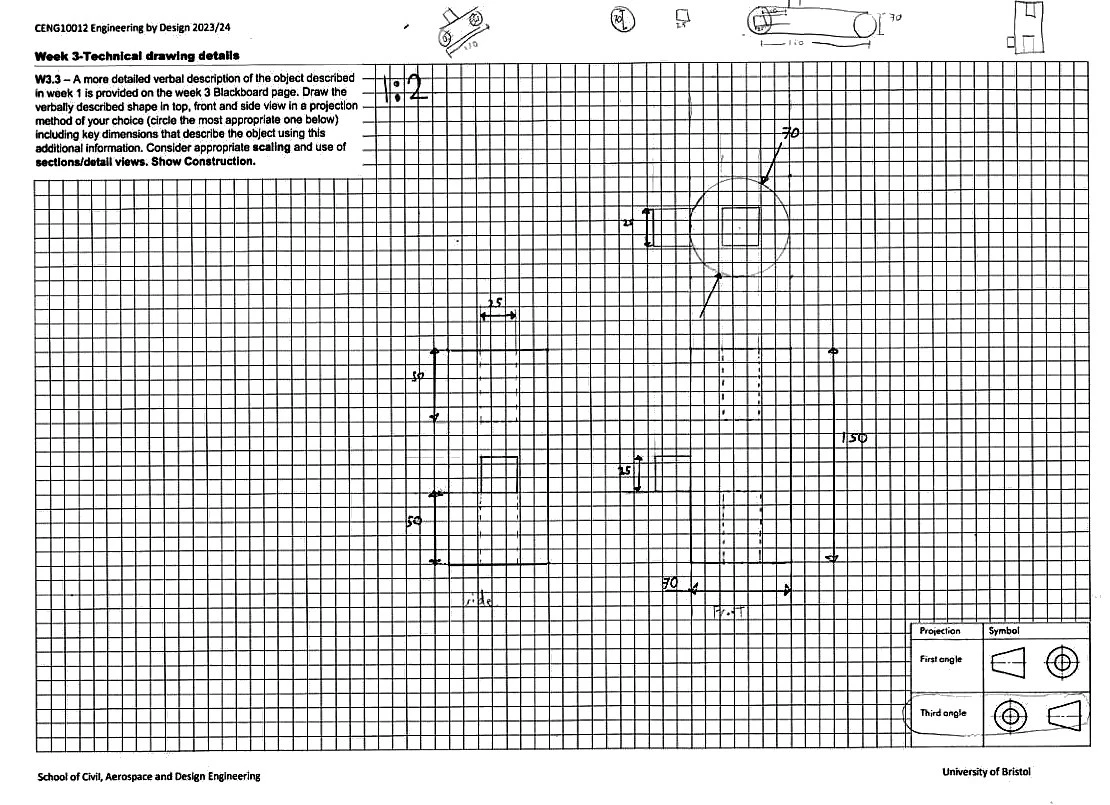
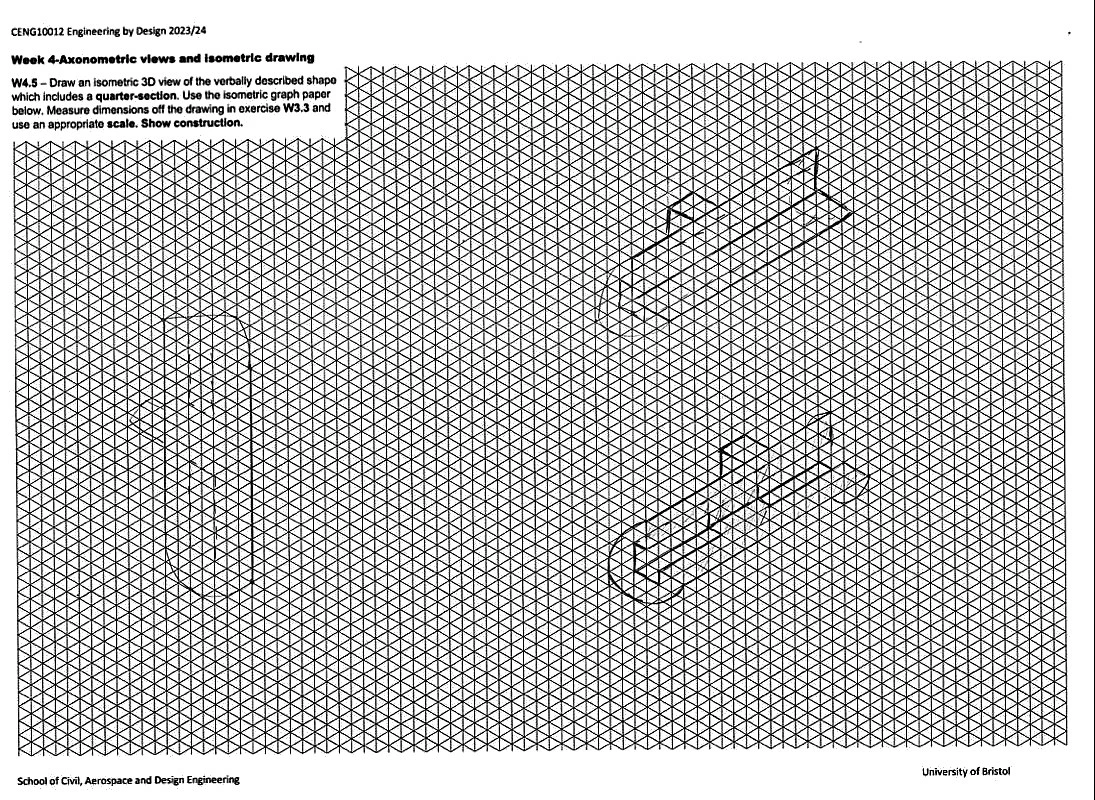
Pencil orthographic drawing on square grid: top, front and side views of a small part with dimensions, thumbnail sketches along the top edge and a projection-symbol box at bottom right
Week 3: top, front and side views with dimensions, at 1:2.
Faint pencil isometric drawing on an isometric grid: a cylindrical part drawn whole and again with a quarter removed to show the section
Week 4: isometric view with a quarter-section. Faint pencil, the weakest of the set.
Pencil two-point perspective of a cylinder with boxes attached, construction lines fanning to vanishing points marked with crosses at each end of the horizon line
Week 5: two-point perspective, construction left in.
04

A Merlin, by hand

Week 7 was an artefact study: pick an object, draw it, annotate it. I drew a SpaceX Merlin 1-D on grid paper, side, front and bottom views, and wrote in what I understood of it: a turbopump delivering propellant at high pressure, a preburner, the combustion chamber where RP-1 and liquid oxygen mix and ignite, a regeneratively cooled nozzle. Drawing no. 0001, Rev 1, November 2023. Fourteen months later I was Engine Lead on Bristol's first liquid engine, Engine 1, firing at 5.94 kN in January 2025. The plate at the top of this page puts the two side by side.

05

CAD

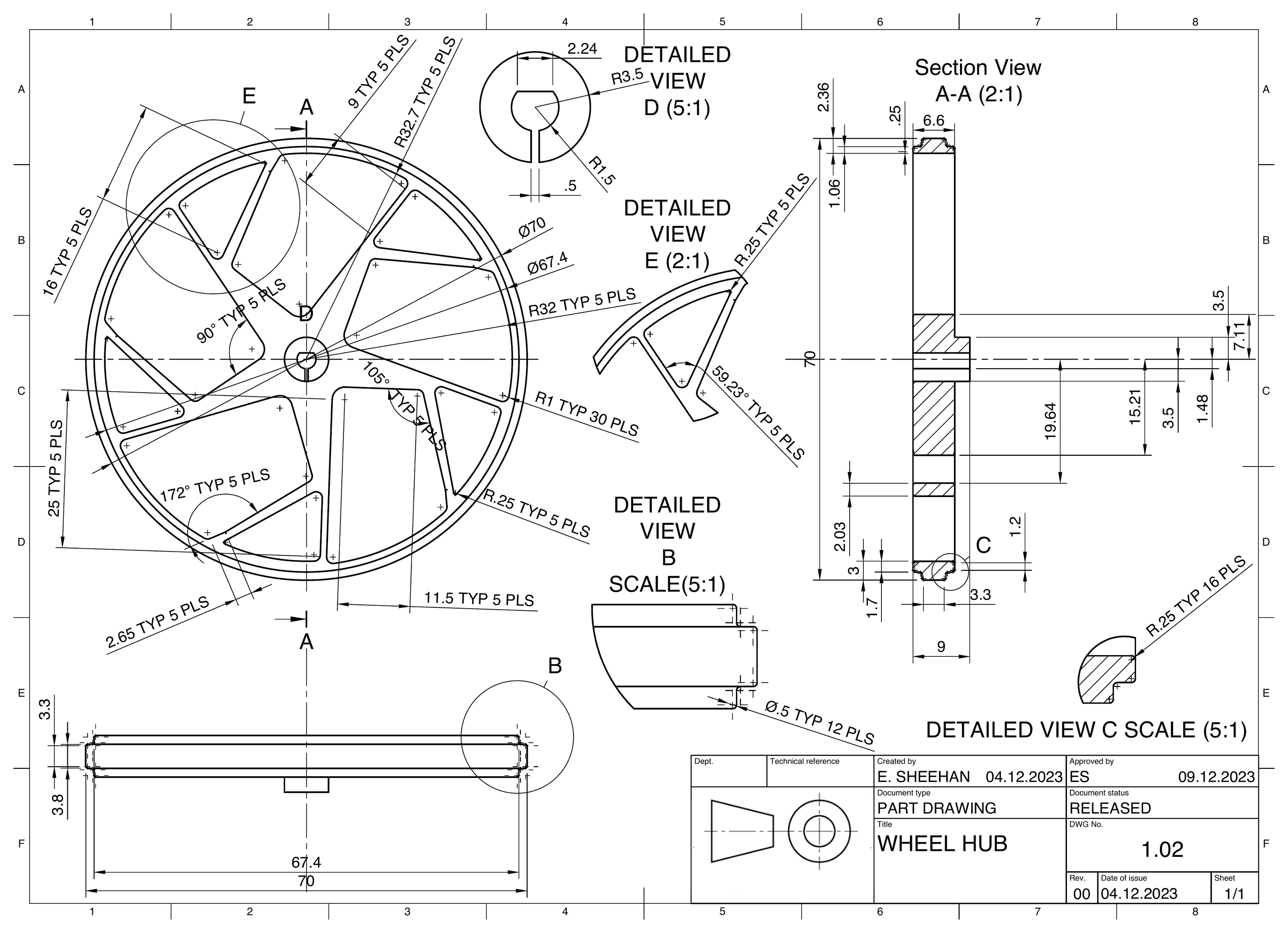
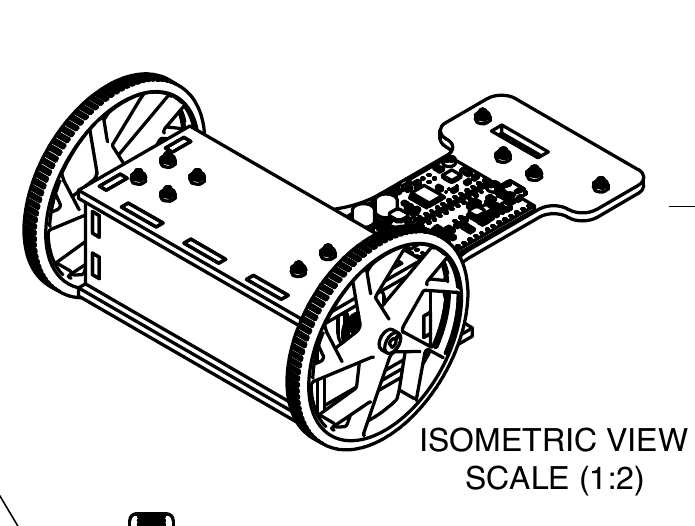
The CAD submission was two sheets on a line-following robot, released 4 December 2023. An assembly drawing with a 19-item parts list (gear motors and brackets, reflectance sensor array, step-down regulator, programmable module, dual serial motor controller, battery pack, ball caster, wheel assemblies), detail views at 2:1 and an isometric at 1:2, on a 179 by 125 mm footprint. And a part drawing of the 70 mm five-spoke wheel hub, with a section and detail views to 5:1. This robot is the Year 1 CAD exercise and is unrelated to the 2026 line-following minidrone project.
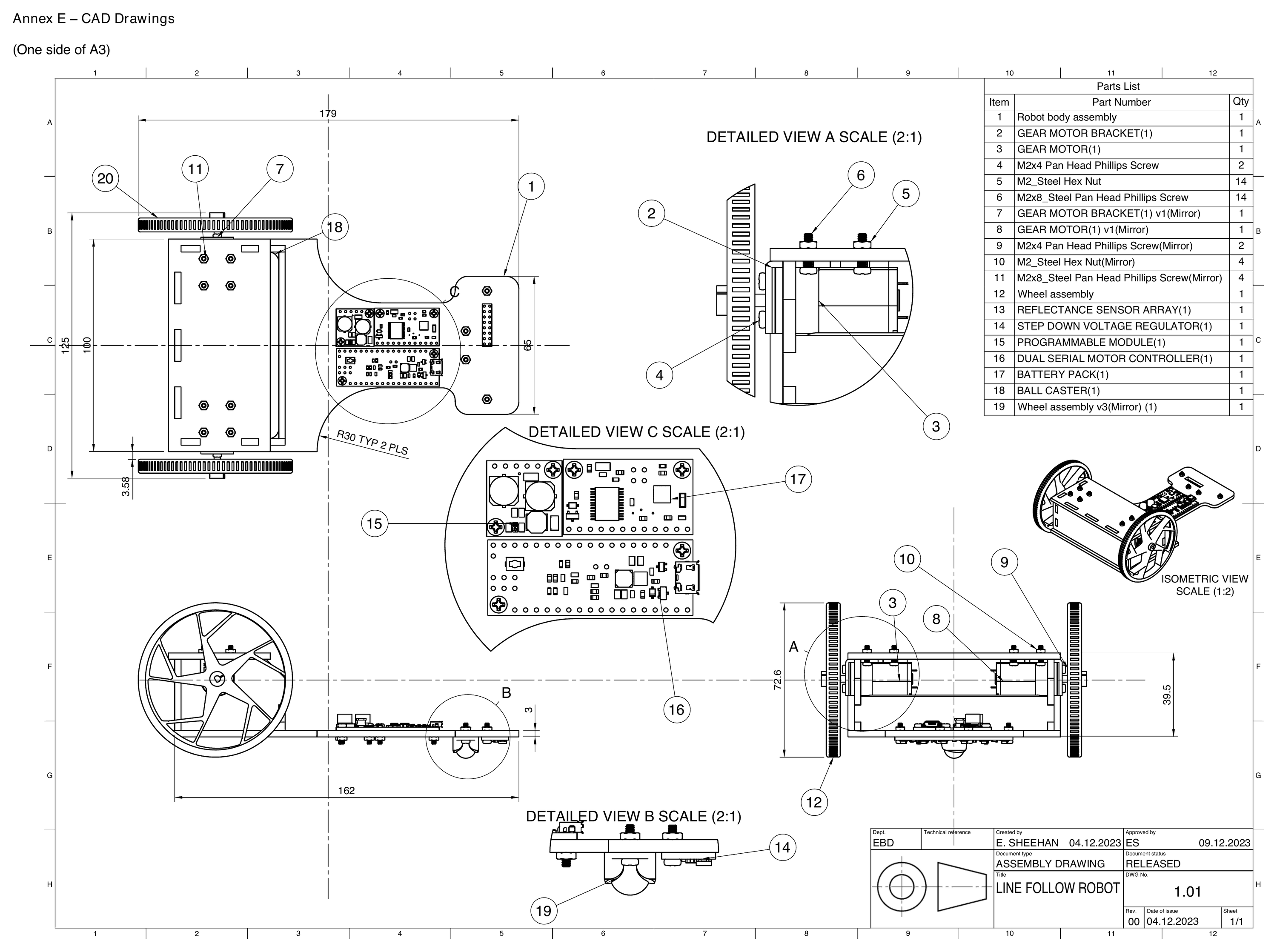
Assembly drawing 1.01 of a two-wheeled line-following robot: plan, side and end views, detail views A to C at 2:1, an isometric at 1:2 and a 19-item parts list
Assembly drawing 1.01, Line Follow Robot, 4 December 2023. 179 by 125 mm footprint.
Isometric line drawing of the line-following robot: a box chassis between two spoked wheels, with a sensor board on a forward arm
Isometric view, 1:2.
Part drawing 1.02 of a 70 mm five-spoke wheel hub: dimensioned front view, section A-A at 2:1, and detail views B to E at 2:1 and 5:1
Part drawing 1.02, Wheel Hub, 4 December 2023.
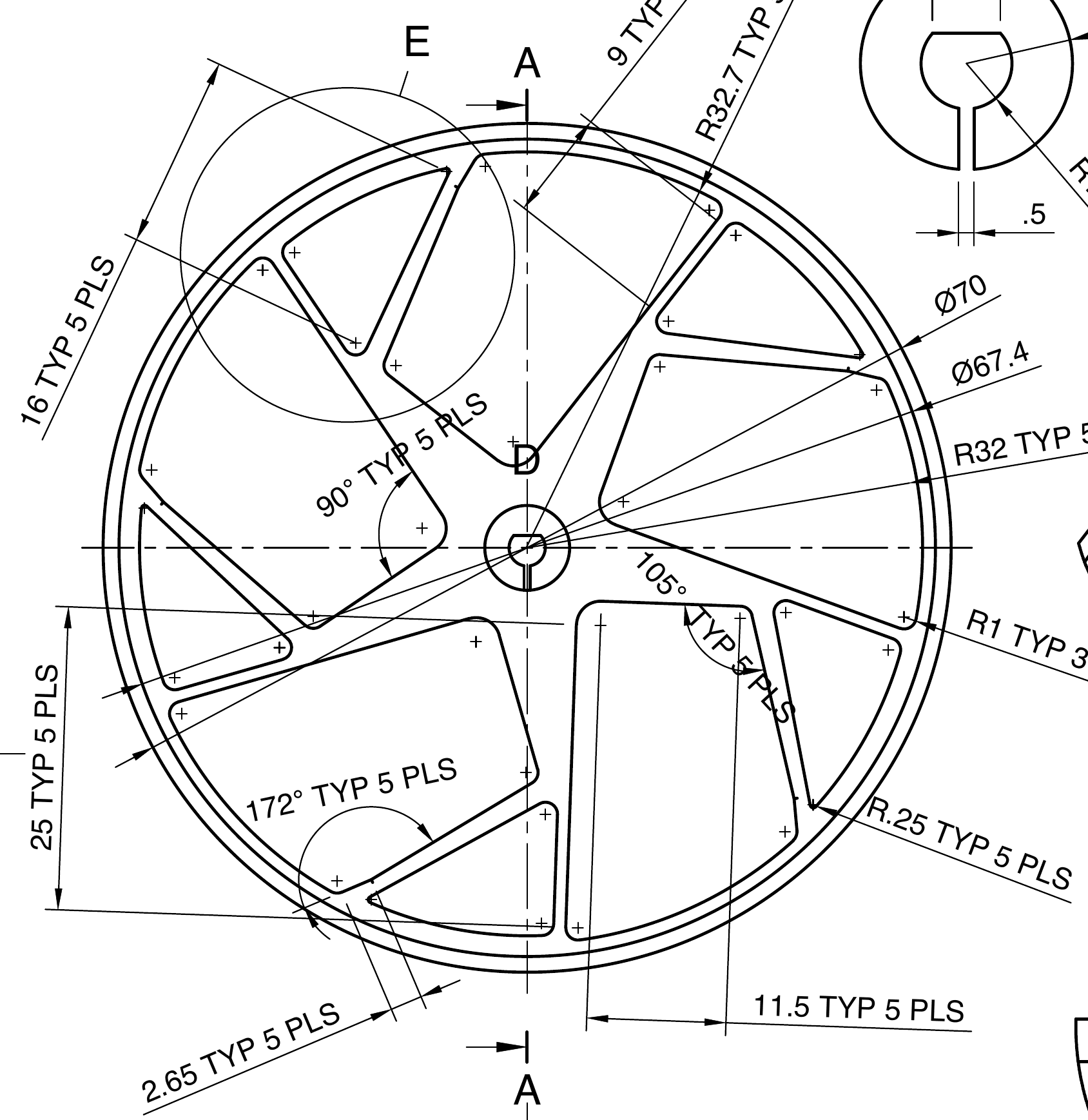
Dimensioned front view of the five-spoke wheel hub, 70 mm diameter, with radii, angles and hole callouts
The wheel hub front view alone.
06

Poster

The four-page A3 poster as submitted, text selectable. A group deliverable; I wrote and formatted it from the team's contributions. It embeds product and stock photographs with their on-poster credits, which is why the pages appear here whole rather than cropped.
Related